
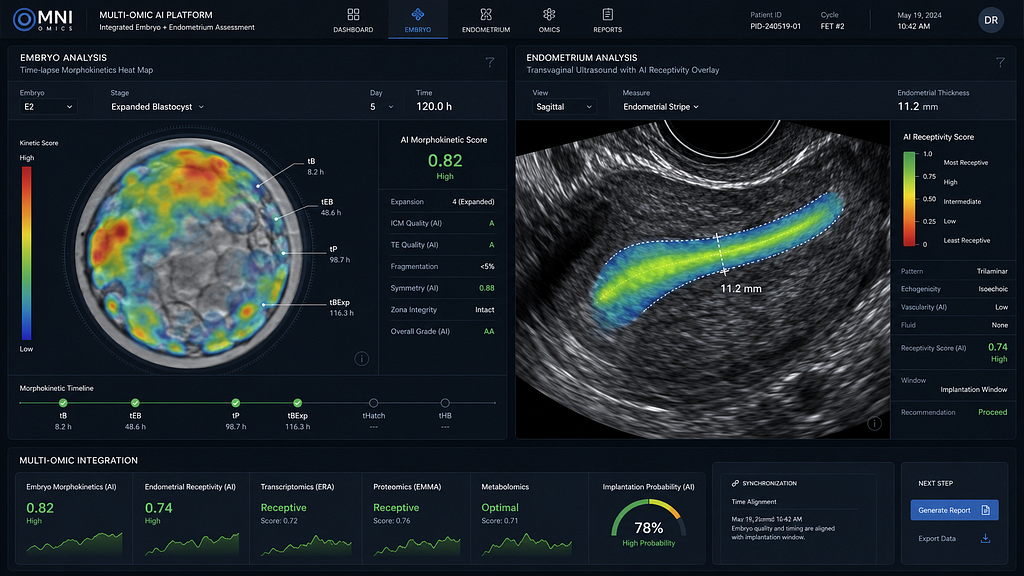
As we reach the midpoint of the week at Science for Smile, we highlight a pivotal leap in precision IVF. Today’s focus is on the latest multidimensional AI frameworks that move beyond the embryo alone, synthesising both embryonic multi-omics and endometrial receptivity to predict the true likelihood of a successful implantation. We are stepping into an era where AI doesn’t just assess the seed; it evaluates the soil.
Clinical question
Does integrating multi-omic embryo profiling (morphokinetics and metabolomics) with AI-derived Endometrial Receptivity Scores (ERS) yield a higher prediction accuracy for live birth rates compared to embryo morphological grading alone?
Mechanism
The “Black Box” of implantation failure often lies in the hidden interaction between a seemingly euploid embryo and the maternal environment. Recent advancements leverage a Combined Scoring (CS) mechanism. First, multi-omic AI analyses the trophectoderm biopsy alongside the secretome of the spent culture media, generating an Embryo Quality Score (EQS) based on metabolic signatures like amino acid turnover. Simultaneously, convolutional neural networks (such as U-Net architectures) evaluate transvaginal ultrasound (TVUS) images to generate an objective Endometrial Receptivity Score (ERS). The system computes a composite index that mathematically maps the synchrony between the embryo’s metabolic vigour and the endometrium’s structural readiness.
Evidence summary
A groundbreaking review in Frontiers in Artificial Intelligence (March 2026) and corresponding data presented in the Fertility and Sterility family of journals demonstrate that AI models embedded in multidimensional scoring frameworks significantly optimise embryo transfer timing. When ERS was combined with multi-omic embryo data, clinicians observed an 8% to 12% increase in the predictive value of Single Embryo Transfers (SET). By generating Heatmap-based saliency maps (e.g., Grad-CAM), these AI models also highlight the exact regions of the endometrium and embryo that drove the predictive score, overcoming traditional trust barriers.
AI workflow
- Multi-Omic Embryo Profiling: The AI system ingests morphokinetic time-lapse data and spent media metabolic markers to assign an objective Embryo Quality Score (EQS).
- Endometrial Segmentation: Transvaginal ultrasounds are processed through a VGG16 backbone neural network, using noise reduction and ROI cropping to map the endometrial stripe and output an Endometrial Receptivity Score (ERS).
- Composite Scoring: The algorithm integrates EQS and ERS, factoring in baseline pregnancy probabilities, to deliver a unified “Implantation Probability Index.”
- Explainable Output: The system generates visual saliency maps, allowing the specialist to review exactly why a specific transfer window is optimal before authorising the final decision.
Limitations/bias
The primary challenge lies in the Data Diversity Gap. AI models trained heavily on Caucasian or distinct regional datasets may misinterpret the morphological variability seen in the Indian demographic. Furthermore, generating synthetic training images via Generative Adversarial Networks (GANs) to mimic morphological diversity requires rigorous external validation in local clinics before widespread deployment.
Practice takeaway
Evaluate the Seed and the Soil Together. For the modern Indian IVF specialist, minimising the emotional and financial toll of failed euploid transfers is paramount. When adopting AI protocols, look for platforms that integrate maternal ultrasound data with embryo kinetics. By moving away from isolated assessments, you can offer patients a truly personalised, data-backed timeline for their Single Embryo Transfer.
Santaan Insight
The Santaan Perspective:
At Santaan Fertility Centre and Research Institute, we have long recognised that a perfect embryo is only half the equation. This global shift toward multidimensional AI scoring directly validates our core philosophy of comprehensive, systemic care. Our proprietary “Precision IVF Protocols” are actively integrating Explainable AI (XAI) to ensure our clinicians are empowered not replaced by these algorithms.
By prioritising models that can be fine-tuned to the unique anatomical and metabolic profiles of the Indian demographic, we are working to eliminate the heartbreak of the “euploid but failed” cycle. True FertiTech innovation isn’t just about adopting the smartest algorithm; it’s about contextualising it for the very real patients sitting in our consultation rooms.
References
- Artificial intelligence models and combined scoring approaches for endometrial receptivity assessment in in vitro fertilisation. Frontiers in Artificial Intelligence, 8 (March 2026).
- Generative AI in Clinical REI Practice: Automating Triage and Decision Support. Fertility and Sterility (2026).
- Integration of multi-omics data for enhanced embryo selection. Nature Reviews Genetics (2026).
For Clinicians: Stay at the forefront of reproductive science. Join our digital health collaborative to access real-time AI-driven benchmarks and advanced dose-prediction tools.
👉 Contact our Clinical Relations Team
https://www.google.com/search?q=https://www.santaan.in/contact-centres
Technical Metadata