
The ‘Digital Twin’ Breakthrough: Moving Ovarian Stimulation from Trial-and-Error to Precision Forecasting
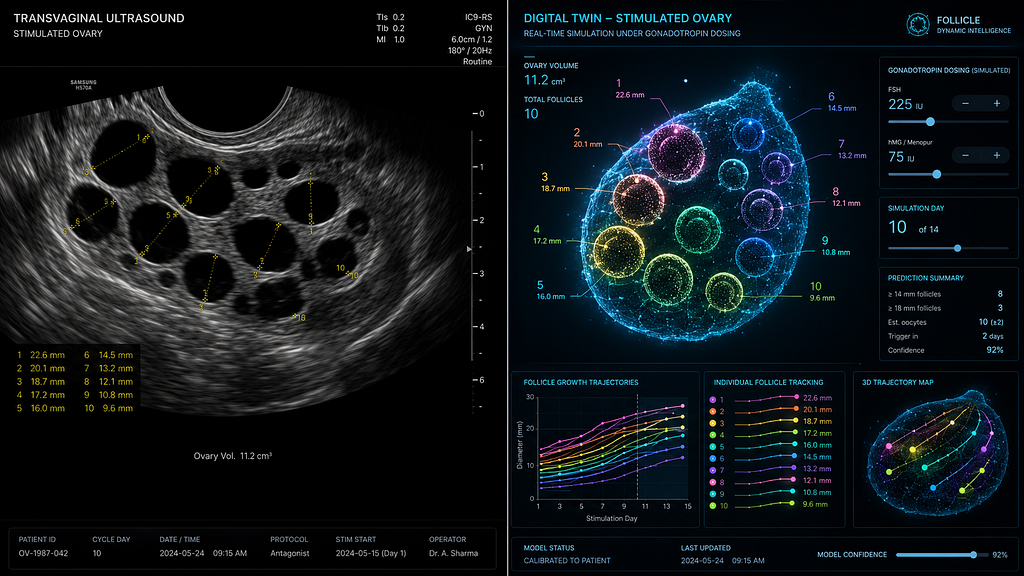
As we head into the weekend at Science for Smile, we look at the rapidly evolving landscape of personalised pharmacology. Today’s focus highlights a breakthrough in how we approach one of the most unpredictable phases of IVF: ovarian stimulation. We are moving from reactive, trial-and-error dosing to proactive, AI-driven cycle forecasting.
Clinical question
Does the use of AI-driven “Digital Twin” modelling utilising patient-specific multi-omic data and Gradient Boosting Regressors improve the prediction of oocyte retrieval yields and reduce the risk of Ovarian Hyperstimulation Syndrome (OHSS) compared to traditional AMH/BMI-based dosing protocols?
Mechanism
Ovarian stimulation protocols have historically relied on static biomarkers like Anti-Müllerian Hormone (AMH), Antral Follicle Count (AFC), and body mass index (BMI). The “Digital Twin” model replaces this static approach with dynamic computational simulation. Using advanced machine learning, specifically Gradient Boosting Regressors, the AI constructs a virtual, multi-dimensional model of the patient’s ovarian response. By analysing historical cycle data, endocrinological profiles, and real-time follicular growth patterns, the AI generates an Individualised Dose-Response Curve. This allows clinicians to virtually “test” different gonadotropin dosages, observing the simulated trade-off between the Number of Oocytes Retrieved (NOR) and the statistical risk of OHSS before the first physical injection is ever administered.
Evidence summary
Recent clinical data and updates highlighted in Human Reproduction (May 2026) and the Journal of Medical Internet Research (JMIR) underscore the clinical superiority of the Digital Twin framework. AI models forecasting ovarian response achieved an impressive R² (coefficient of determination) of 0.79 for predicting the final NOR, significantly outperforming traditional heuristic protocols. By simulating the cycle computationally, these models allowed for precise, real-time “course correction” during stimulation, adjusting dosages to synchronise the entire follicular cohort rather than solely reacting to the lead follicle. This predictive capability directly translated to a lowered incidence of severe OHSS while maximising euploid blastocyst yields.
AI workflow
- Data Ingestion: The patient’s baseline metrics (AMH, AFC, BMI, age) and historical cycle data are fed into the Gradient Boosting Regressor model.
- Virtual Simulation: The AI constructs the “Digital Twin,” simulating various gonadotropin dosing scenarios (e.g., antagonist vs. agonist protocols) and outputting expected follicular trajectories.
- Precision Prescribing: The specialist reviews the AI’s predictive curves to select a protocol that maximises NOR while strictly maintaining OHSS risk below the patient’s acceptable threshold.
- Dynamic Monitoring: During the cycle, real-time automated ultrasound volumetrics (like FOLLISCAN) are fed back into the model to continuously update the Digital Twin, allowing for micro-adjustments and exact “trigger” timing.
Limitations/bias
The key limitation is the Data Quality Dependency. A Digital Twin is only as accurate as the historical dataset upon which it was trained. In the Indian context, where patients frequently present with unique phenotypic expressions of Polycystic Ovary Syndrome (PCOS) and varying baseline nutritional statuses, models trained primarily on Western demographics risk hallucinating cycle predictions. Rigorous local calibration of the algorithm is essential before clinical reliance.
Practice takeaway
Simulate Before You Stimulate. For Indian IVF specialists managing high-risk PCOS populations or poor responders, the trial-and-error days of gonadotropin dosing are ending. Integrating predictive AI models allows you to “preview” a cycle’s outcome, reducing medication waste, minimising patient risk, and fostering deep patient trust. When upgrading your clinic’s software stack, prioritise platforms that offer dynamic forecasting, not just static dosing guidelines.
Santaan Insight
The Santaan Perspective:
At Santaan Fertility Centre and Research Institute, we recognise that the physical and financial toll of a cancelled cycle or severe OHSS is devastating for our patients. The “Digital Twin” breakthrough aligns perfectly with our commitment to highly personalised, empathetic care. By pioneering predictive modelling in our clinics, we are not just prescribing medication; we are engineering outcomes. This allows our clinicians to engage patients with a mathematically backed roadmap, turning the unpredictability of IVF into a finely tuned, proactive science tailored to the unique physiological landscape of the Indian woman.
References
- Integrated Prediction System for Individualised Ovarian Stimulation and OHSS Prevention. JMIR Medical Informatics, 2026.
- The Digital Twin in Reproductive Medicine: Moving from static biomarkers to dynamic simulation. Fertility and Sterility, May 2026.
- Artificial intelligence in predicting ovarian response: a multicenter validation study. Journal of Assisted Reproduction and Genetics, 2026.
For Clinicians: Stay at the forefront of reproductive science. Join our digital health collaborative to access real-time AI-driven benchmarks and advanced dose-prediction tools.
👉 Contact our Clinical Relations Team
https://www.google.com/search?q=https://www.santaan.in/contact-centres
Technical Metadata