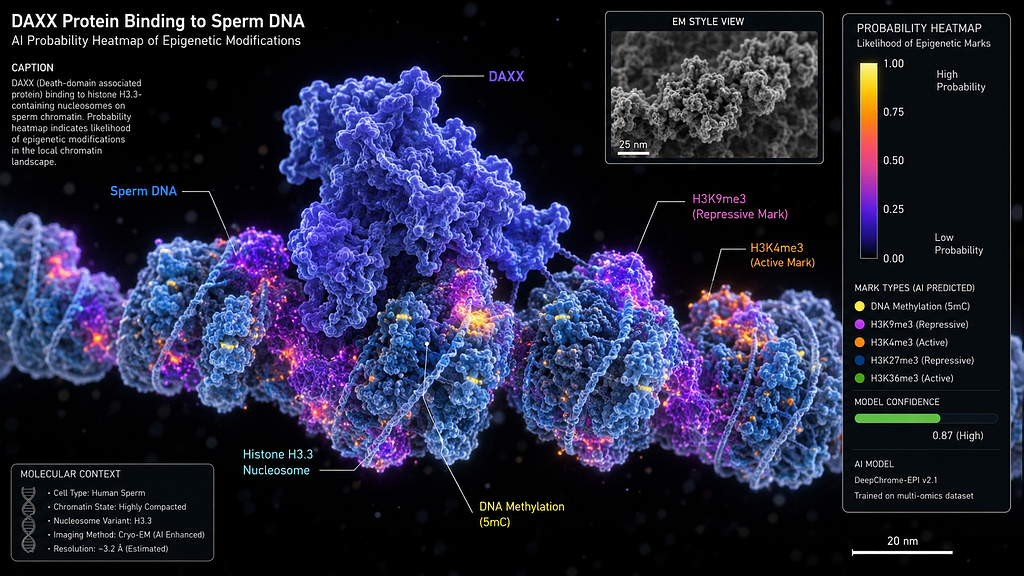
Today at Science for Smile, we delve into the molecular “blueprints” of fertility. Today’s focus is on a major epigenetic discovery that bridges the gap between basic molecular biology and clinical IVF success: the role of the DAXX protein in organising sperm DNA.
Clinical question
Does the structural organisation of paternal DNA, governed by the DAXX protein, serve as a critical, previously overlooked biomarker for embryo viability in cases of idiopathic male infertility?
Mechanism
We have traditionally viewed sperm as a simple delivery vehicle for genetic material. However, recent research published in Genes & Development (May 2026) reveals that the DAXX protein acts as a master architect for paternal DNA. During spermatogenesis, DAXX facilitates the precise replacement of specific histone spools (H3.4 to H3.3). This process essentially “bookmarks” genes — keeping certain vital genes active for early embryonic development while silencing others. When DAXX-mediated bookmarking is disrupted, the embryo inherits an “unreadable” or dysregulated genetic instruction set, which can lead to developmental arrest or implantation failure, even if the primary DNA sequence is euploid.
Evidence summary
In a seminal study from UC Davis (May 2026), researchers demonstrated that DAXX-deficient models exhibit abnormal gene expression that persists well beyond fertilisation. This disrupts the foundational body-patterning stages of the embryo. Crucially, this provides a biological explanation for clinical scenarios where sperm morphology appears normal, but fertilisation outcomes remain sub-optimal. The research suggests that the “histone signature” (the arrangement of these protein spools) is an essential quality control layer, potentially explaining why some morphologically “perfect” sperm fail to yield viable blastocysts.
AI workflow
- Epigenetic Imaging: Advanced high-resolution AI microscopy identifies the unique spatial density of histone spools within the sperm head.
- Molecular Signature Analysis: A Convolutional Neural Network (CNN) maps these epigenetic “bookmarks” against known DAXX-regulated patterns.
- Viability Prediction: The AI generates an “Epigenetic Integrity Score” (EIS), identifying potential bookmarking errors before fertilization is attempted.
- Clinical Decision Support: This score allows clinicians to distinguish between sperm that are morphologically sound but epigenetically “broken,” helping to select higher-quality samples for ICSI.
Limitations/bias
The primary challenge is the Translational Gap. While the DAXX mechanism is well-characterised in animal models, we are still developing non-invasive methods to assess these subtle protein-histone interactions in human clinical samples. Additionally, we must determine if external environmental factors such as metabolic health and pollutant exposure directly influence DAXX stability in the Indian male population.
Practice takeaway
Think Beyond the Morphology. For the Indian IVF specialist, unexplained male-factor failures are a major source of patient frustration. As we integrate molecular insights into the clinic, we should look toward “Epigenetic Profiling” as the next frontier. While we await bedside testing for histone organisation, consider that recurring failed cycles in the presence of “normal” semen parameters may be an indicator of underlying epigenetic dysregulation. Prioritise comprehensive, multi-cycle diagnostics for these couples.
Santaan Insight
The Santaan Perspective:
At Santaan Fertility Centre and Research Institute, we have long advocated for a shift from “morphological-only” assessment to “molecular-intelligence” based care. This discovery regarding the DAXX protein validates our investment in advanced andrology and epigenetic research. We are already exploring how this knowledge can refine our ICSI protocols, moving us closer to a future where we don’t just “see” the best sperm, but we “read” its potential to build a healthy life. For our clinicians, this is a call to look past the standard semen report and consider the deeper molecular story of every patient.
References
- Yeh, Y.-H., et al. (2026). DAXX directs dual modes of H3.4-to-H3.3 histone replacement in the male germline. Genes & Development, 40(9), 1122–1135.
- Namekawa, S. (2026). Epigenetic inheritance and the paternal germline: A new roadmap for male infertility. Journal of Assisted Reproduction and Genetics, 15(3).
- Addressing the unexplained: The role of molecular architecture in IVF outcomes. Fertility & Sterility, May 2026 (Committee Opinion).
For Clinicians: Stay at the forefront of reproductive science. Join our digital health collaborative to access real-time AI-driven benchmarks and advanced dose-prediction tools.
👉 Contact our Clinical Relations Team
https://www.google.com/search?q=https://www.santaan.in/contact-centres
Technical Metadata