
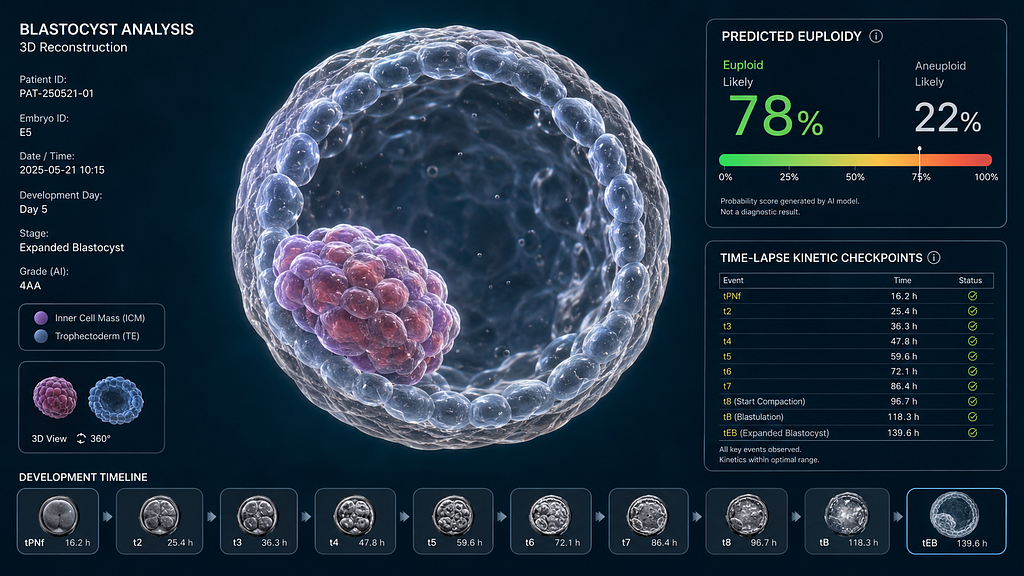
As we open a new clinical week at Science for Smile, we look toward a major shift in our industry’s “Standard of Care.” For years, the field of embryology has debated the invasiveness of genetic screening versus the subjectivity of morphological grading. This morning, however, a synthesis of recent multicenter data, highlighted in Frontiers in Reproductive Health and Human Reproduction, suggests we are firmly entering the era of the “Hybrid Lab.” In this new paradigm, AI acts as the vital bridge between non-invasive imaging and predictive genetics.
Clinical Question
Can AI-driven analysis of spent culture medium (niPGT-A) combined with time-lapse imaging (TLI) achieve non-inferiority to invasive trophectoderm (TE) biopsy for predicting embryonic ploidy and implantation potential?
The Mechanism
The “biopsy-free” dream relies on two distinct data streams:
1. The Embryonic Secretome: Cell-free DNA (cfDNA) released into the culture medium during blastocyst expansion.
2. Developmental Kinetics: The precise timing of cellular cleavage events.
AI utilises a Multi-Stream Neural Network to fuse these data points. It effectively filters out maternal DNA noise from the media while simultaneously correlating specific milestones, like t5 and tSB (sub-blastocyst timing), with chromosomal normality. By analysing these non-linear kinetic signatures, the AI generates a predictive Ploidy Probability Score without touching a single embryonic cell.
Evidence Summary
In a retrospective head-to-head analysis of 1,681 embryo pairs across six international centres (published in RBMO late 2025 and updated for 2026 review), AI models achieved 70.1% accuracy in identifying embryos with the highest likelihood of live birth. This performance surpassed the mean accuracy of individual embryologists (67.7%) and matched the consensus of a 20-member expert committee.
Furthermore, recent May 2026 reports on niPGT-A suggest that when AI is deployed to analyse spent media, concordance rates with traditional Next-Generation Sequencing (NGS) biopsies reach between 75% and 95%, depending on the robustness of the dataset.
The AI Workflow
1. Non-Invasive Sampling: Spent culture medium is collected on Day 5 or 6, while TLI kinetic data is seamlessly pulled from the incubator.
2. Data De-noising: An AI-driven bioinformatic pipeline separates the target embryonic cfDNA from maternal cumulus cell contamination.
3. Kinetic Matching: A Convolutional Neural Network (CNN) cross-references the genetic signature with the embryo’s “Kinetic Fingerprint” (from t2 through tB).
4. Ranked Decision: The clinician receives a comprehensive “Hybrid Score” combining genetic probability and morphological viability to confidently guide elective Single Embryo Transfer (eSET).
Limitations & Bias
The “Black Box” nature of AI still poses a challenge for clinical interpretation. It remains difficult to explain to a patient why an algorithm discarded an embryo that “looked” perfect under a microscope. Additionally, as noted in recent ResearchGate reviews (April 2026), current models can exhibit “Performance Drift” when transitioned between different laboratory environments or culture media brands. Prioritising generalizability validation is essential before niPGT-A can universally replace TE biopsy.
Practice Takeaway
Transition, don’t just replace.
For Indian specialists, the most immediate value of AI is not in replacing the skilled embryologist, but in reducing cognitive workload and evaluation time by 30–50% per cohort. Start by integrating AI-ranking as a “Standardised Second Reader” to support eSET decisions. This approach is especially powerful for patients hesitant about the costs or perceived risks of invasive PGT-A.
By embracing and celebrating the science of non-invasive screening, we can offer our patients a safer, data-backed path to a smile.
References
1. Evaluating the concordance between AI-based and conventional embryo selection: implications for clinical decision-making. PMC / RBMO, 2025–2026.
2. The integration of artificial intelligence in assisted reproduction: a comprehensive review. Frontiers in Reproductive Health, May 2026.
3. Artificial Intelligence in in-vitro fertilisation (IVF): A New Era of Precision and Personalisation. ResearchGate, April 24, 2026.
For Clinicians: Stay at the forefront of reproductive science. Join our digital health collaborative to access real-time AI-driven benchmarks and advanced dose-prediction tools.
👉 Contact our Clinical Relations Team
https://www.google.com/search?q=https://www.santaan.in/contact-centres
Technical Metadata