
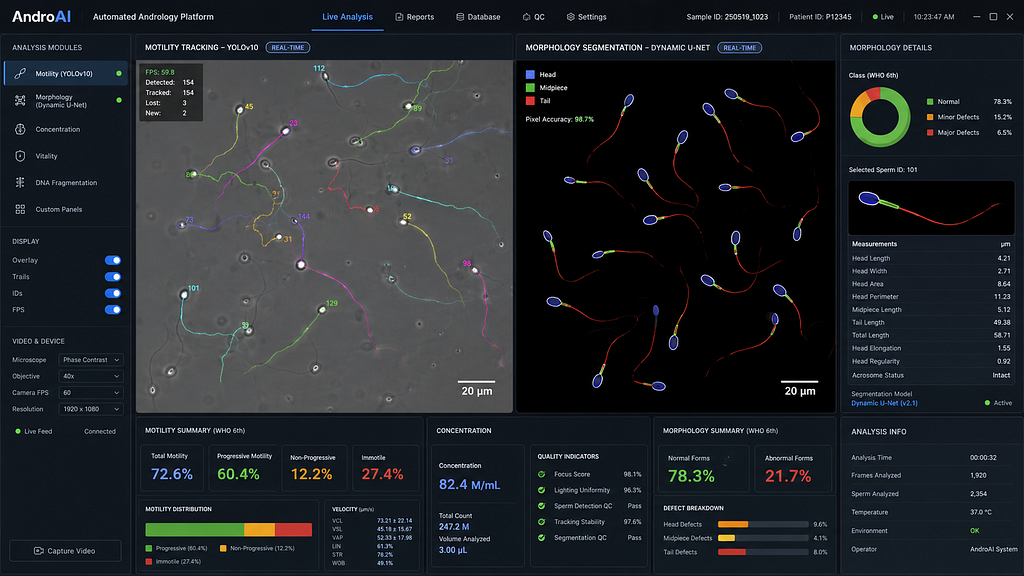
Today at Science for Smile, we turn our gaze toward a frequently under-innovated space in reproductive medicine: the andrology lab. Today’s focus highlights recent literature from early 2026 on lightweight, point-of-care AI architectures. We are moving away from the subjective, labour-intensive manual semen analysis toward autonomous, real-time diagnostic systems that operate directly at the microscope’s edge.
Clinical question
Does integrating lightweight deep neural networks (such as Dynamic U-Net) and split-strategy AI models for automated semen analysis provide higher diagnostic accuracy and clinical efficiency compared to traditional, manual WHO-guided assessments?
Mechanism
Evaluating sperm quality remains a notoriously subjective task, suffering from high inter-observer and intra-observer variability. To capture the complex, curved morphology of a moving sperm cell, traditional deep learning required massive computational power.
The newest “split-strategy” AI architectures solve this by dividing the labor. First, rapid object-detection models (like YOLOv10) track individual sperm trajectories in real-time to quantify concentration and motility. Simultaneously, advanced morphological segmentation models — specifically the newly developed Dynamic U-Net (Dy-UNet) and Segment Anything Model 2 (SAM-2) — perform pixel-wise mapping. Using innovations like “dynamic snake convolution,” these lightweight models adapt to the curved, undulating structures of the sperm head, midpiece, and tail without the need for cell-killing stains, delivering an objective morphological analysis on live samples.
Evidence summary
Recent 2026 data published in Artificial Intelligence in Health introduces the Dy-UNet model, demonstrating a paradigm shift in computational efficiency. This architecture achieved state-of-the-art segmentation accuracy — surpassing baseline models by 17% to 25% — while operating on a mere 184K parameters. Parallel research published in MDPI (January 2026) validates this approach, showing that automated frameworks can instantly generate comprehensive, WHO-compliant semen analysis reports. These AI systems provide extreme precision in identifying faint morphological defects that the human eye routinely misses, fundamentally upgrading the predictive value of the standard semen analysis.
AI workflow
- Real-Time Tracking: Unstained, live microscopic video feeds are processed by a YOLO-based tracking algorithm, instantly calculating sperm concentration and kinematic motility grades (progressive vs. non-progressive).
- Anatomical Segmentation: The system utilises models like Dy-UNet or SAM-2 to isolate and map the exact boundaries of the sperm head, midpiece, and tail.
- Autonomous Classification: The AI cross-references the segmented pixels against strict WHO morphological guidelines to identify abnormalities (e.g., vacuolated heads or bent midpieces).
- Clinical Reporting: A standardised, objective fertility report is generated instantly, empowering the clinician with quantitative data rather than subjective estimates.
Limitations/bias
While these lightweight models are designed for mobile and embedded clinic systems, they still face the Debris and Clarity Challenge. High background noise, severe agglutination, or excessive cellular debris in minimally processed clinical samples can confuse tracking algorithms. Furthermore, models trained predominantly on specific global datasets must be validated against the morphological baselines seen within the diverse Indian demographic to avoid skewed anomaly reporting.
Practice takeaway
Standardise the Semen Analysis. As Indian IVF specialists, we know that male factor infertility accounts for half of our clinical challenges, yet the diagnostic tools have lagged behind female reproductive tech. When upgrading your andrology lab, prioritise lightweight, AI-driven CASA (Computer-Aided Sperm Analysis) systems. These tools offer instant, objective, and WHO-compliant evaluations at the point of care, eliminating human fatigue and giving your patients a precise roadmap for whether to proceed with IUI, conventional IVF, or ICSI.
Santaan Insight
The Santaan Perspective:
At Santaan Fertility Centre and Research Institute, we believe that true clinical excellence requires addressing both halves of the fertility equation with equal technological rigour. The advent of lightweight, deployable AI for sperm morphology perfectly aligns with our mission to democratise high-level precision medicine.
By integrating these autonomous, point-of-care andrology tools into our clinics, we remove the guesswork from male fertility assessments. This ensures that every patient walking through our doors in India receives a standardised, objective diagnosis — allowing us to tailor treatments like ICSI with absolute confidence, saving time, reducing costs, and ultimately bringing our patients closer to their dream of parenthood.
References
- Zhang, Q., et al. (2026). Dynamic U-Net: A lightweight hierarchical network for accurate and efficient sperm morphology segmentation. Artificial Intelligence in Health.
- AI-Powered Fertility Insights: An Automated Human Sperm Analysis via Deep Learning. MDPI, 16(2) (January 2026).
- Top Fertility Tests for Men in 2026: Integrating AI with Semen Analysis. Andrology Centre Clinical Reports (2026).
For Clinicians: Stay at the forefront of reproductive science. Join our digital health collaborative to access real-time AI-driven benchmarks and advanced dose-prediction tools.
👉 Contact our Clinical Relations Team
https://www.google.com/search?q=https://www.santaan.in/contact-centres
Technical Metadata