
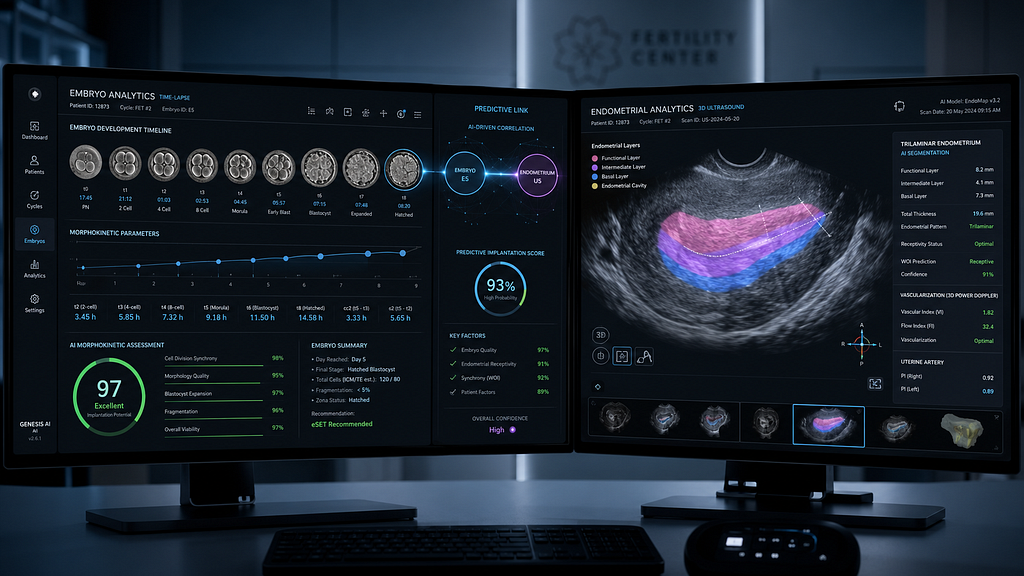
Today at Science for Smile, we shift our lens from the embryology bench to the critical intersection of the lab and the clinical transfer room. For decades, we have evaluated the embryo and the endometrium in silos. Today, we delve into a paradigm-shifting update in FertiTech: how multidimensional Artificial Intelligence is finally bridging the gap by integrating deep learning of embryo morphokinetics with automated uterine receptivity mapping to perfect Frozen Embryo Transfer (FET) timing.
Clinical question
Can multi-dimensional AI scoring frameworks that seamlessly integrate time-lapse embryo morphokinetics with real-time automated endometrial segmentation significantly improve implantation and live birth rates in FET cycles compared to traditional isolated assessments?
Mechanism
Historically, an embryologist selects the best embryo based on morphological grading, while the clinician independently assesses the endometrium via 2D ultrasound.
The latest multi-dimensional AI frameworks utilise a dual-network approach to remove this disconnect. First, Vision Transformers (ViT) continuously process millions of data points from time-lapse videos to evaluate embryo growth dynamics and compute a predictive viability score. Simultaneously, U-Net Convolutional Neural Networks (CNNs) perform real-time, highly precise segmentation of the patient’s transvaginal ultrasound (TVUS). The system automatically extracts endometrial thickness, pattern (trilaminar vs. hyperechoic), and 3D volume. Finally, an integrated algorithmic composite evaluates the “long-range” biological dependencies between the specific embryo’s developmental pace and the real-time uterine environment, calculating an exact synchronisation window for transfer.
Evidence summary
Groundbreaking clinical data published this year in Frontiers in Artificial Intelligence highlights the massive clinical utility of integrated scoring systems (such as the EQS-ERS-PSART composite). In multicenter prospective cohorts, the dual AI framework achieved a remarkable Area Under the Curve (AUC) of 0.94 for biochemical pregnancy prediction. Modern U-Net architectures also demonstrated a Dice Similarity Coefficient (DSC) of 0.92, matching the exact accuracy of senior sonographers in delineating endometrial boundaries. Most importantly, by evaluating the embryo and the uterus as an interconnected ecosystem, clinics reported a nearly 25% reduction in recurrent implantation failures (RIF) among complex patient cohorts.
AI workflow
- Data Ingestion: The AI platform aggregates time-lapse imaging from the incubator and real-time TVUS imaging from the clinic’s Electronic Medical Record (EMR).
- Automated Uterine Mapping: U-Net algorithms autonomously segment the endometrial lining, instantly calculating volume, thickness, and optimal receptivity patterns without manual caliper placement.
- Embryo Viability Scoring: Deep learning models rank the available euploid blastocysts based on subtle morphokinetic milestones invisible to the human eye.
- Composite Synchronisation: The system cross-references the selected embryo’s predicted implantation energy against the patient’s current endometrial receptivity score, generating a highly personalised, day-by-day transfer recommendation.
Limitations/bias
The Achilles’ heel of this technology is data fragmentation. For the AI to function optimally, fertility clinics must have deeply integrated systems in which ultrasound feeds and embryology lab data can communicate without manual data entry. Furthermore, while the U-Net algorithm drastically reduces inter-operator variability in measuring the endometrium, it still relies on the initial quality and angle of the sonogram captured by the technician. Unstructured or low-quality legacy imaging can lead to skewed predictive scores and hinder the model’s accuracy.
Practice takeaway
Evaluate the ecosystem, not just the isolated cell. For Indian IVF specialists, the integration of multi-dimensional AI represents a shift from subjective observation to precision fertility medicine. By automating endometrial segmentation and linking it directly to embryo grading, you can standardise your FET protocols and drastically reduce the cognitive load on both clinicians and embryologists. Embracing these composite scoring models allows your team to confidently pinpoint the optimal window of implantation, ultimately decreasing the emotional and financial strain of repeated cycles for your patients.
Santaan Insight
At Santaan, we believe that the future of reproductive medicine lies in the seamless integration of every touchpoint in the patient journey. Selecting a beautifully expanded blastocyst is only half the battle; transferring it into a perfectly synchronised environment is what creates a family. By pioneering the adoption of multi-dimensional AI scoring and automated endometrial mapping across our centres, we ensure that our clinical and embryology teams operate with a unified, data-driven perspective. We remain committed to “Human-in-the-Loop” AI — using these powerful tools to empower our specialists’ clinical intuition, not replace it.
References
- Artificial intelligence models and combined scoring approaches for endometrial receptivity assessment. Frontiers in Artificial Intelligence, 2026. (PMID: 401443104)
- Automation, Artificial Intelligence (AI), and Digital Management in IVF Laboratories: Current Status, Challenges and Potential. Reproductive Sciences, April 2026.
- Artificial intelligence in embryo selection: enhancing precision and overcoming traditional limitations in in vitro fertilization. International Journal of Reproduction, Contraception, Obstetrics and Gynecology, February 2026.
Technical metadata:
- Editor: @santaanIVF
- Audience: #audience-doctor
- Tags: #audience-doctor #doctor-insights #FertiTech #AIinIVF #Embryology #PrecisionMedicine #SantaanIVF #FertilityTrends