
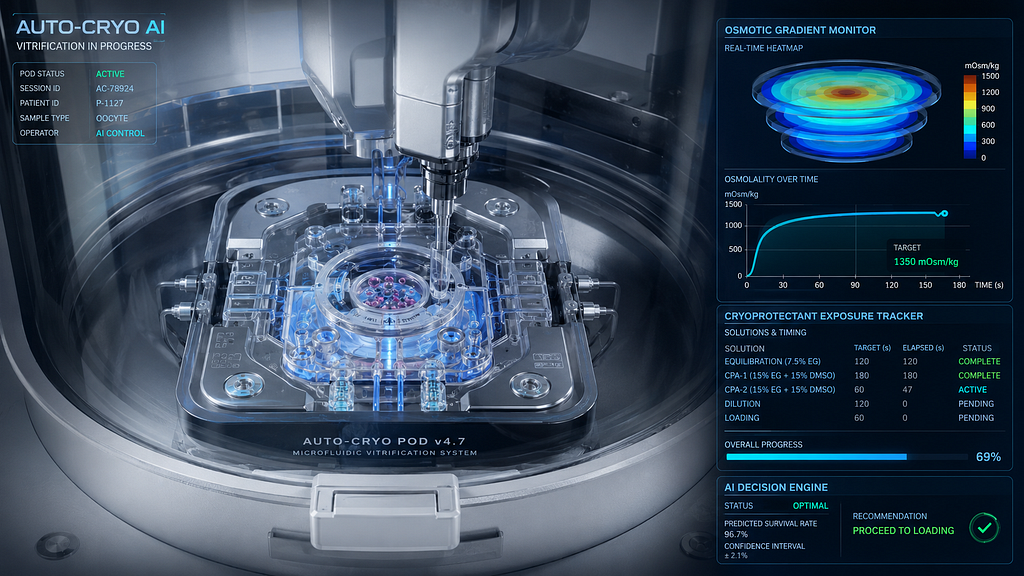
As we advance through the week at Science for Smile, we turn our focus to the busiest station in any modern IVF laboratory: the cryopreservation bench. Vitrification revolutionised fertility preservation, but the process remains highly manual, tedious, and stressful. Today, we explore a major leap forward in laboratory automation, examining how AI-driven computer vision and robotic microfluidics are working together to eliminate the need for pipettes.
Clinical question
Can AI-powered computer vision paired with robotic microfluidics eliminate operator variability during the embryo vitrification process, thereby reducing osmotic stress and improving post-thaw survival rates compared to manual cryopreservation?
Mechanism
Manual vitrification is notoriously dependent on the embryologist’s dexterity. Moving an oocyte or blastocyst through increasingly concentrated gradients of toxic cryoprotectants (CPA) requires flawless timing to prevent fatal osmotic shock.
The newest automated vitrification platforms utilise high-speed AI optical tracking integrated with robotic liquid handlers. Rather than manually moving the embryo from drop to drop, the embryo remains stationary within a specialised microfluidic pod. The AI algorithm visually tracks the embryo’s shrinkage and re-expansion in real-time, autonomously calculating its precise osmotic equilibrium. Based on this continuous visual feedback, robotic pipettors dynamically adjust the flow and concentration of the CPA, ensuring the exact minimum exposure required before initiating an automated, closed-system plunge into liquid nitrogen.
Evidence summary
Recent multicenter data published in Nature Scientific Reports highlights that AI-driven automated vitrification systems demonstrate a significant reduction in inter-operator variability. The robotic platforms achieved a 99.1% post-thaw survival rate for blastocysts, matching the absolute best outcomes of senior embryologists, but with 100% consistency across different laboratory environments. Furthermore, automated closed-system vitrification drastically reduced the incidence of sub-lethal cryo-damage by eliminating the micro-fluctuations in timing and handling temperature that naturally occur during human processing.
AI workflow
- Target Acquisition: The AI camera system identifies and locks onto the target oocyte or embryo within the sterile microfluidic holding chamber.
- Dynamic Perfusion: Robotic micro-pumps introduce the equilibration and vitrification solutions, while the AI continuously tracks the cell’s real-time osmotic membrane response.
- Automated Sealing: Once optimal cellular equilibrium is optically confirmed, the system autonomously heat-seals the pod, maintaining a strictly closed environment.
- Precision Storage: The pod is mechanically transferred directly into the liquid nitrogen dewar, freeing the embryologist to focus on immediate patient care tasks.
Limitations/bias
The primary limitation is the immense initial capital expenditure required to install automated robotic systems. While the technology reduces long-term consumable and labour costs, the upfront hardware investment remains prohibitive for many smaller clinics. Additionally, while the AI can perfectly execute the CPA exposure and cooling rate, any underlying genetic or metabolic fragility inherent to the embryo before freezing will still ultimately dictate its true viability upon warming.
Practice takeaway
Standardise the Freeze. For Indian IVF centres looking to scale operations reliably, the laboratory bottleneck often lies in the time-consuming cryopreservation process. Automated robotic vitrification removes human fatigue from the equation, ensuring that embryo number 1 receives the same flawless freezing protocol as embryo number 10 at the end of a long shift. Embracing automation safeguards your laboratory’s most precious assets while allowing your highly skilled embryologists to focus their expertise on high-value tasks like ICSI and patient counselling.
Santaan Insight
At Santaan, we recognise that consistency is the absolute foundation of clinical excellence. Vitrification is one of the most critical procedures in the lab because the margin for error is essentially zero. By exploring the integration of AI-driven robotic automation into our cryopreservation workflows across our clinics in Bhubaneswar and pan-India, we aim to eliminate human fatigue as a variable. When we automate the freeze, we protect our patients’ future families with mathematical precision, ensuring that the hope they store today remains perfectly intact for tomorrow.
References
- Autonomous Vitrification in an Intelligent Automated in Vitro Fertilisation Platform. Nature Scientific Reports. nature.com
- Novel automated instrument executing a standardised closed vitrification protocol yields equivalent outcomes with human blastocysts. Human Reproduction. pubmed.ncbi.nlm.nih.gov
- AI and Microfluidics in the Embryology Laboratory: The Future of Automation. Frontiers in Reproductive Health. frontiersin.org
Technical metadata:
- Editor: @santaanIVF
- Audience: #audience-doctor
- Tags: #audience-doctor #doctor-insights #predictive-modeling #PatientSafety #Fertility