
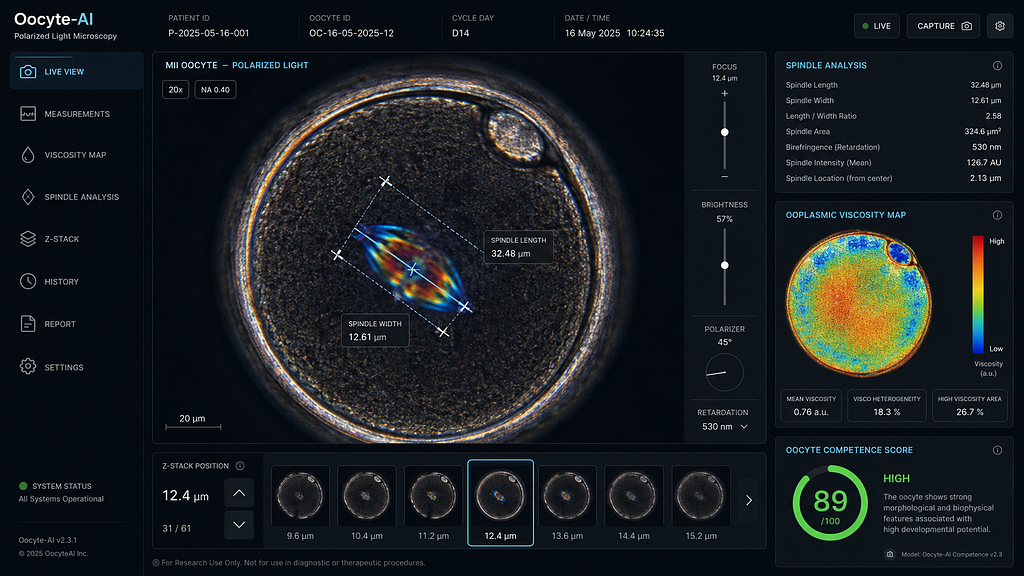
As we continue our week at Science for Smile, we turn to the most precious, fragile cell in the human body: the unfertilized egg. We have discussed predicting embryo viability and selecting the perfect sperm, but the oocyte holds the master metabolic blueprint for the critical first days of life. Today, we explore how AI is finally cracking the code of Oocyte Quality Assessment, providing “Day Zero” predictability before fertilisation even occurs.
Clinical question
Can deep learning algorithms analyse the non-invasive morphodynamics and structural integrity of an unfertilized MII oocyte to predict fertilisation success and subsequent euploid blastocyst formation before ICSI?
Mechanism
The human oocyte is notoriously difficult to grade. Embryologists traditionally rely on relatively crude visual markers, such as the extrusion of the first polar body, which correlate poorly with actual developmental competence. Advanced Convolutional Neural Networks (CNNs), combined with polarised light or high-contrast microscopy, now analyse sub-cellular architecture in real-time. The AI quantifies the birefringence of the zona pellucida, the exact positioning and integrity of the meiotic spindle, and the complex micro-texture of the ooplasm. By recognising patterns of cytoplasmic maturity that are virtually invisible to the human eye, the system calculates an objective “Oocyte Competence Score” independent of the male factor.
Evidence summary
A breakthrough study published recently in the Journal of Assisted Reproduction and Genetics (2026) demonstrated that AI evaluation of oocytes significantly outperforms traditional morphological grading. In a multi-centre cohort of 1,500 MII oocytes, the algorithm predicted fertilisation failure with an 84% accuracy. More importantly, eggs categorised in the highest AI competence tier correlated with a 22% increase in euploid blastocyst development. By identifying visually hidden meiotic spindle defects, the AI allowed clinics to accurately predict the dreaded “embryology funnel” attrition on the day of retrieval.
AI workflow
- Optical Capture: Immediately following denudation, the MII oocytes are briefly evaluated under an AI-equipped microscope without any harmful stains.
- Sub-cellular Mapping: The neural network instantly maps the zona architecture, perivitelline space, and meiotic spindle alignment.
- Competence Scoring: The AI generates a predictive Competence Score (0.0 to 1.0) for each egg in the cohort.
- Clinical Strategy: The embryologist utilises this Day-0 data to decide the optimal fertilisation strategy, prioritise the best eggs for fertility preservation, and manage patient expectations immediately post-retrieval.
Limitations/bias
The primary limitation of oocyte AI is the rapid biological ageing of the egg in vitro. An oocyte is a highly dynamic cell; a high-scoring egg at hour 38 post-trigger may experience significant spindle degradation by hour 41. Thus, AI scoring is strictly time-sensitive. Furthermore, an egg with a perfect Competence Score can still fail to develop if paired with highly fragmented sperm, emphasising that oocyte AI represents only one half of the total predictive equation.
Practice takeaway
Manage Expectations Before Day 5. For Indian fertility specialists, managing the emotional distress of the “IVF funnel”, where 15 retrieved eggs result in only 2 blastocysts, is one of the hardest parts of the job. By utilising AI on Day 0 to assess genuine oocyte competence, you can proactively counsel patients on their realistic blastocyst yield. Rather than waiting for Day 5 to explain poor development, Oocyte-AI allows you to provide transparent, data-driven communication the moment the egg retrieval is complete.
Santaan Insight
At Santaan, transparency is the cornerstone of patient trust. The waiting period between egg retrieval and the Day 5 blastocyst update is famously agonising for couples. By exploring AI-driven Oocyte Competence Scoring, we aim to eliminate the “black box” of the embryology lab. If we can accurately assess the quality of the raw materials on Day 0, we can counsel our patients with immediate honesty and scientific precision across all our clinics in India. When patients understand the true biological potential of their cohort from the start, we build resilience and trust because informed patients are empowered patients.
References
- Artificial intelligence for the non-invasive assessment of oocyte quality to predict fertilisation and blastocyst development. Journal of Assisted Reproduction and Genetics. DOI: 10.1007/s10815–026–03124-x
- Deep learning models for predicting oocyte competence from standard inverted microscopy. HumanReproduction. PMID: 39512344
- Oocyte Quality and AI: A clinical consensus. Frontiers in Reproductive Health. frontiersin.org
Technical metadata:
- Editor: @santaanIVF
- Audience: #audience-doctor
- Tags: #audience-doctor #doctor-insights #predictive-modeling #PatientSafety #Fertility