
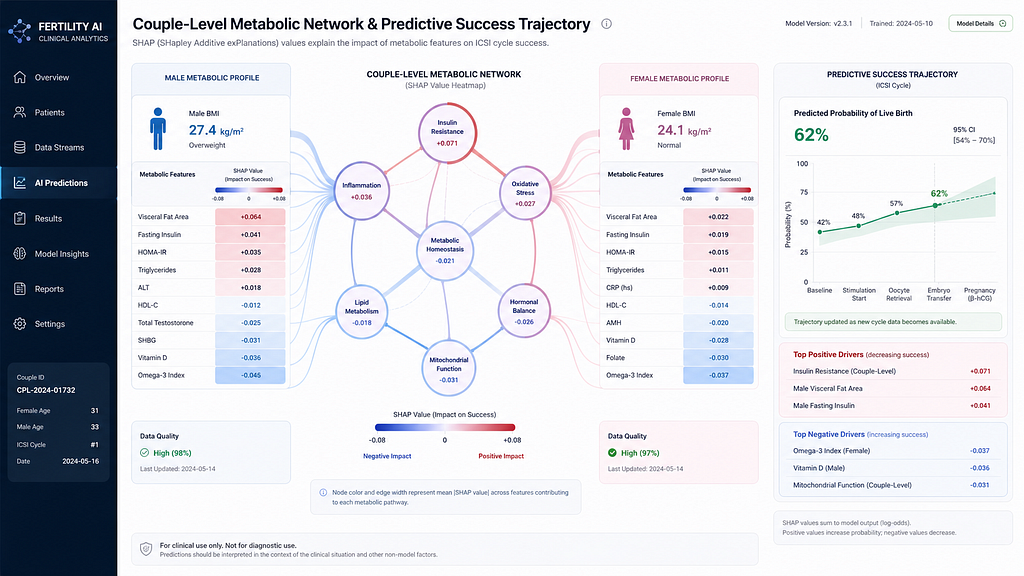
As we continue our week at Science for Smile, we are pivoting our analytical lens away from the embryology lab and into the initial consultation room. Today’s focus, drawing from newly published data in Frontiers in Endocrinology (May 2026), addresses a historical blind spot in reproductive modelling: the male partner. We are exploring how advanced machine learning is redefining the baseline for IVF/ICSI success by treating metabolic health as a strictly “couple-level” equation.
Clinical question
Can machine learning models leveraging “couple-level” preprocedural variables, specifically male factor infertility and combined metabolic status (BMI), accurately predict clinical pregnancy outcomes in IVF/ICSI cycles before stimulation?
Mechanism
Historically, clinical prediction models have disproportionately weighed female ovarian reserve markers (AMH, AFC), often treating the male partner’s metabolic and seminal contributions as secondary variables. Utilising advanced gradient boosting frameworks like LightGBM, integrated with SHAP for interpretability, AI can now map high-dimensional, non-linear relationships. Instead of treating male and female BMI in isolation, these algorithms identify synergistic “couple-level” metabolic signatures. The model calculates precisely how combined metabolic health directly influences ICSI fertilisation competence, allowing clinicians to visualise the exact weight of the male factor in the early developmental trajectory.
Evidence summary
Recent data published in Frontiers in Endocrinology (May 2026) shifts the spotlight toward male factor infertility. Researchers analysed over 2,500 couples undergoing their first IVF/ICSI cycle, noting that generic AI models fail to capture the nuances of severe oligozoospermia or asthenozoospermia. By deploying a specialised LightGBM model, the team achieved an impressive Area Under the Curve (AUC) of 0.857 in predicting pregnancy outcomes. Crucially, the SHAP analysis proved that combined spousal BMI, basal FSH, and AMH were the defining predictive features — confirming that the male partner’s metabolic health is an active, heavily weighted variable rather than just a passive bystander in embryonic development.
AI workflow
- Coupled Data Ingestion: The algorithm continuously digests preprocedural data from both partners simultaneously during the first consultation, effectively removing the female-centric bias in early data modelling.
- Non-Linear Modelling: The LightGBM framework maps complex, non-linear interactions, such as how an elevated male BMI mathematically interacts with a borderline female AMH.
- Interpretability (SHAP): The system generates a visual SHAP plot for the specialist, explicitly detailing which variables (and from which partner) are driving the probability score up or down.
- Targeted Counselling: Specialists utilise this individualised, dual-risk profile to mandate targeted metabolic interventions, such as male weight management or nutritional supplementation, before initiating the ICSI cycle.
Limitations/bias
While highly accurate at the baseline, these preprocedural ML models face a persistent Generalisation Challenge. Because the Frontiers study used a single-centre retrospective dataset, the model’s heavy reliance on specific BMI interactions may suffer from “Dataset Drift” when applied to diverse demographic cohorts, such as those with the highly varied dietary and metabolic profiles seen across different Indian states. Furthermore, preprocedural AI cannot account for unpredictable intra-cycle variables, such as sudden shifts in laboratory culture conditions or epigenetic triggers.
Practice takeaway
Treat the Couple, Not Just the Cycle. For Indian fertility specialists, the data is a clear mandate to bring the male partner fully into the metabolic spotlight. When an AI prediction model highlights couple-level BMI as a critical failure point for ICSI, it shifts the clinical conversation from mere gamete extraction to holistic, pre-cycle metabolic optimisation. Utilise these interpretable ML models during the first consultation to personalise lifestyle interventions, potentially elevating your ICSI success rates before the first injection is even given.
Santaan Insight
At Santaan, we recognise that true precision medicine requires evaluating the entire reproductive equation. As AI continues to evolve, we are moving beyond siloed, female-centric prediction models to embrace holistic, couple-level analytics. By integrating advanced machine learning algorithms and SHAP interpretability into our preliminary patient assessments, we empower our clinicians to offer targeted, dual-partner lifestyle and metabolic guidance. We believe that optimising the health of both partners through intelligent, data-driven insights is the foundation for successful ICSI, ultimately reducing cycle failures and bringing the dream of a healthy family closer to reality.
References
- Machine learning–based prediction of IVF/ICSI outcomes in male factor infertility, highlighting couple-level BMI. Frontiers in Endocrinology, May 2026.
- Machine Learning-Based Prediction of IVF Outcomes: The Central Role of Preprocedural Factors. MDPI, 13(11), 2026.
- Integrating nutrition and artificial intelligence in reproductive health: advancing precision fertility medicine. Int J Reprod Contracept Obstet Gynecol, 15(5), May 2026.
For Clinicians: Stay at the forefront of reproductive science. Join our digital health collaborative to access real-time AI-driven benchmarks and advanced dose-prediction tools.
👉 Contact our Clinical Relations Team
https://www.google.com/search?q=https://www.santaan.in/contact-centres
Technical Metadata