
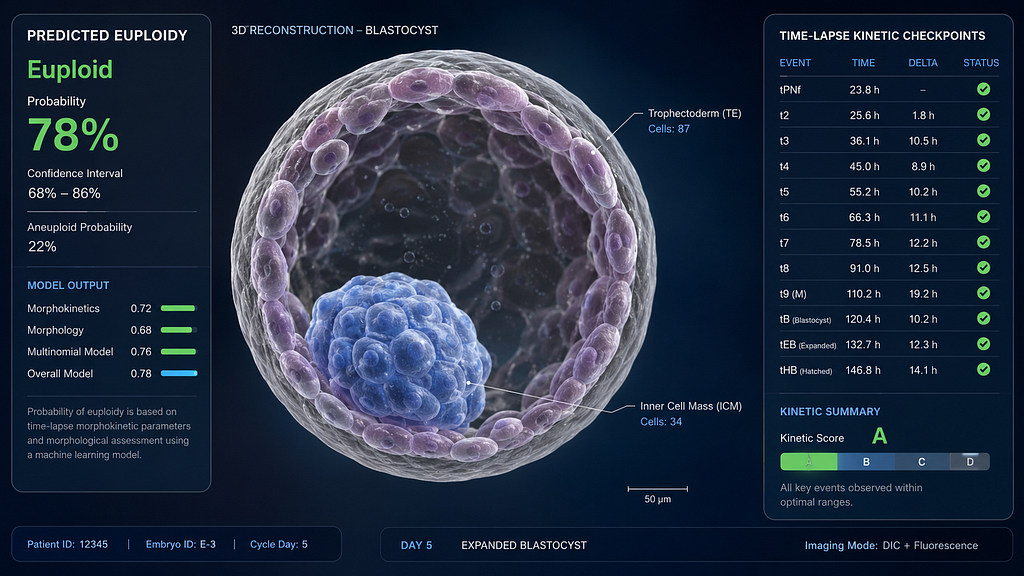
As we open a new clinical day at Science for Smile, we are witnessing a fundamental shift in the IVF “Standard of Care.” The long-standing debate, subjective morphological grading versus invasive genetic screening, is finally finding a resolution.
Recent multicentre data suggest we are entering the era of the Hybrid Lab, where AI serves as the vital bridge between non-invasive imaging and predictive genetics.
The Clinical Question
Can AI-driven analysis of spent culture medium (niPGT-A) and time-lapse imaging (TLI) achieve non-inferiority to invasive trophectoderm (TE) biopsy for predicting ploidy and implantation potential?
The Mechanism: Multi-Stream Neural Networks
The “biopsy-free” future relies on the fusion of two distinct biological data streams:
• The Embryonic Secretome: Cell-free DNA (cfDNA) released into the culture medium during blastocyst expansion.
• Developmental Kinetics: The precise timing of cleavage events (from $t_2$ through $t_B$).
By utilising a Multi-Stream Neural Network, the AI filters out maternal DNA “noise” while simultaneously correlating sub-visual kinetic signatures with chromosomal normality. This allows for a Ploidy Probability Score generated without the mechanical trauma of a biopsy.
Evidence Summary (May 2026 Update)
A retrospective analysis of 1,681 pairs across six international centres (published in RBMO) yields compelling results:
• Predictive Accuracy: AI models achieved 70.1% accuracy in identifying embryos with the highest live-birth potential, surpassing the mean accuracy of individual embryologists (67.7%).
• Concordance: Modern niPGT-A reports suggest that when AI is used to analyse spent media, concordance rates with traditional NGS biopsies now range between 75% and 95%.
The AI Workflow
1. Non-Invasive Sampling: Spent culture medium is collected on Day 5/6, and TLI kinetic data is pulled directly from the incubator.
2. Data De-noising: An AI-driven bioinformatic pipeline isolates embryonic cfDNA from maternal cumulus cell contamination.
3. Kinetic Matching: The Convolutional Neural Network (CNN) matches the genetic signature with the embryo’s “Kinetic Fingerprint.”
4. Ranked Decision: The clinician receives a Hybrid Score, combining genetic probability and morphological viability, to guide elective Single Embryo Transfer (eSET).
Limitations: The “Black Box” and Performance Drift
Despite the promise, two hurdles remain. First, the “Black Box” of AI poses a challenge for patient counselling; it is difficult to explain why an AI might de-prioritise an embryo that looks “perfect” to the human eye. Second, as noted in recent April 2026 reviews, models can experience “Performance Drift” when introduced to different lab environments or media brands. Generalizability Validation remains the final frontier before universal adoption.
Practice Takeaway
Transition, don’t just replace.
For specialists in the Indian market, the immediate value of AI is in workload reduction, cutting manual grading time by 30–50% per cohort. Start by using AI-ranking as a Standardized Second Reader to support eSET decisions. This is an especially powerful tool for patients concerned about the costs or risks of invasive procedures.
By celebrating the science of non-invasive screening, we can offer a safer, data-backed path to a smile.
References
1. Evaluating the concordance between AI-based and conventional embryo selection: implications for clinical decision-making. RBMO, 2026.
2. The integration of artificial intelligence in assisted reproduction: a comprehensive review. Frontiers in Reproductive Health, May 2026.
3. Artificial Intelligence in in-vitro fertilisation (IVF): A New Era of Precision and Personalisation. ResearchGate, April 24, 2026.
For Clinicians: Stay at the forefront of reproductive science. Join our digital health collaborative to access real-time AI-driven benchmarks and advanced dose-prediction tools.
👉 Contact our Clinical Relations Team
https://www.google.com/search?q=https://www.santaan.in/contact-centres
Technical Metadata