
Welcome to Science for Smile. While embryo selection often dominates the discourse in fertility medicine, today we are shifting our focus earlier, to the “pre-embryo” stage.
A pivotal study recently published in Reproductive BioMedicine Online (RBMO), and backed by the latest clinical data from May 2026, explores the role of Artificial Intelligence (AI) in standardising one of the most subjective tasks in the IVF lab: selecting the individual spermatozoon for ICSI.
The Clinical Question
Does the use of AI-based, real-time sperm selection software improve blastocyst development rates compared to manual selection by senior embryologists, particularly in cases involving compromised oocyte quality?
The Mechanism
Traditionally, manual sperm selection for ICSI relies on visible motility and gross morphology. However, human observation is inherently limited by subjective bias and the frame rate of the human eye.
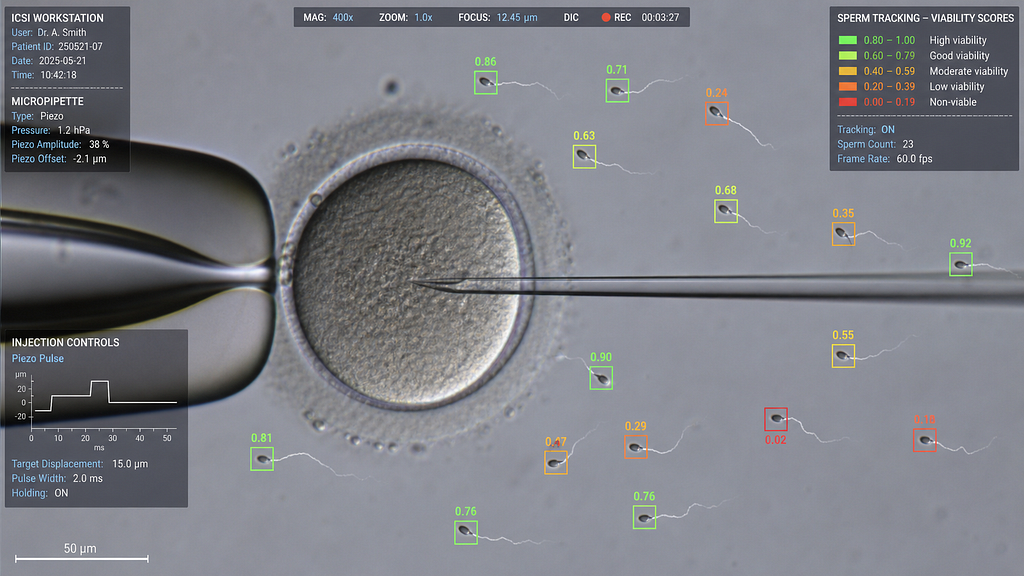
Artificial Intelligence Sperm Selection (AISS) platforms, such as the Sperm ID (SiD™) system, bypass these limitations using high-speed computer vision. They quantify specific kinetic parameters at the individual cell level, including:
- Curvilinear Velocity (VCL)
- Amplitude of Lateral Head Displacement (ALH)
By comparing these metrics in real-time against vast datasets of successful fertilisation events, the AI assigns a categorical score (e.g., ‘Best,’ ‘Good,’ ‘Medium’) to guide the embryologist’s micropipette.
Evidence Summary
In a double-blind observational study published in late 2025 and widely corroborated in May 2026 literature, researchers evaluated over 100 couples. The findings revealed a crucial distinction:
- Autologous Oocytes: In cycles where oocyte quality was variable, the use of AI-ranked “Best” sperm was associated with a significantly higher blastocyst formation rate compared to manual selection.
- Donor Oocytes: In cycles with a high-quality baseline, the AI and senior embryologists performed almost identically.
The takeaway: AI’s true clinical utility shines in “difficult” cases. When the margin for error is slim, the sperm’s molecular contribution becomes critical to rescuing a compromised cycle.
The AI Workflow in Practice
- Real-Time Tracking: As the embryologist scans the PVP drop, the AI overlays a tracking ID onto every moving spermatozoon.
- Kinetic Profiling: The system instantly calculates the cell’s Curvilinear Velocity (VCL), Straight-Line Velocity (VSL), and Average Path Velocity (VAP).
- Automated Ranking: Each sperm is colour-coded based on its statistical probability of being “functionally competent.”
- Selection & Injection: The embryologist selects the sperm with the highest AI rank, ensuring the most kinetically stable candidate is microinjected.
Limitations and Blind Spots
While powerful, AISS is not without limitations. The software primarily assesses kinetic and morphological markers; it cannot “see” DNA fragmentation or the chromatin status of the sperm head in real-time without specialised staining (which is lethal to the cell). Furthermore, the current predictive models are optimised for swim-up samples. Their performance in cases of severe oligospermia or with TESE (Testicular Sperm Extraction) samples still requires further clinical validation.
Practice Takeaway
Precision starts at the pipette. For Indian clinics managing an increasing volume of advanced maternal age patients or cases of “unexplained” IVF failure, AI sperm selection offers a vital layer of quality control.
By providing a standardised, data-driven second opinion during the high-pressure ICSI procedure, this technology effectively gives every junior embryologist the eye of a senior expert. Clinics should consider implementing AISS for autologous cycles to squeeze every possible percentage point of potential out of their blastocyst conversion rates.
References
1. Automated AI for real-time sperm selection in ICSI: reducing variability and studying the role of sperm in embryo development. PMC / PubMed, 2025–2026.
2. Artificial Intelligence in in-vitro fertilisation (IVF): A New Era of Precision and Personalisation. ResearchGate, May 2026.
3. Non-invasive evaluation of endometrial receptivity via AI: Surpassing EMT thresholds. Human Reproduction (ESHRE Journals), 2026.
For Clinicians: Stay at the forefront of reproductive science. Join our digital health collaborative to access real-time AI-driven benchmarks and advanced dose-prediction tools.
👉 Contact our Clinical Relations Team
https://www.google.com/search?q=https://www.santaan.in/contact-centres
Technical Metadata