As we navigate the mid-week surge of clinical developments, the May 2026 issue of Human Reproduction has delivered a seminal contribution to the ethical and structural integration of AI. Today’s Science for Smile explores the evolution of AI from an opaque “black box” to a “Standardised Witness”, a shift proving as critical for medicolegal accountability as it is for clinical success.
The Clinical Question
Can the integration of AI-based witnessing and annotation systems effectively eliminate human error in laboratory workflows and provide a more reliable “Ground Truth” for outcome prediction than traditional manual verification?
The Mechanism
In high-volume IVF laboratories, “witnessing” (the double-checking of gamete and embryo identity) is a mission-critical task highly susceptible to human fatigue.
• AI Witnessing Systems: Utilise high-resolution overhead surveillance and machine learning to perform continuous, automated verification of RFID-tagged labware.
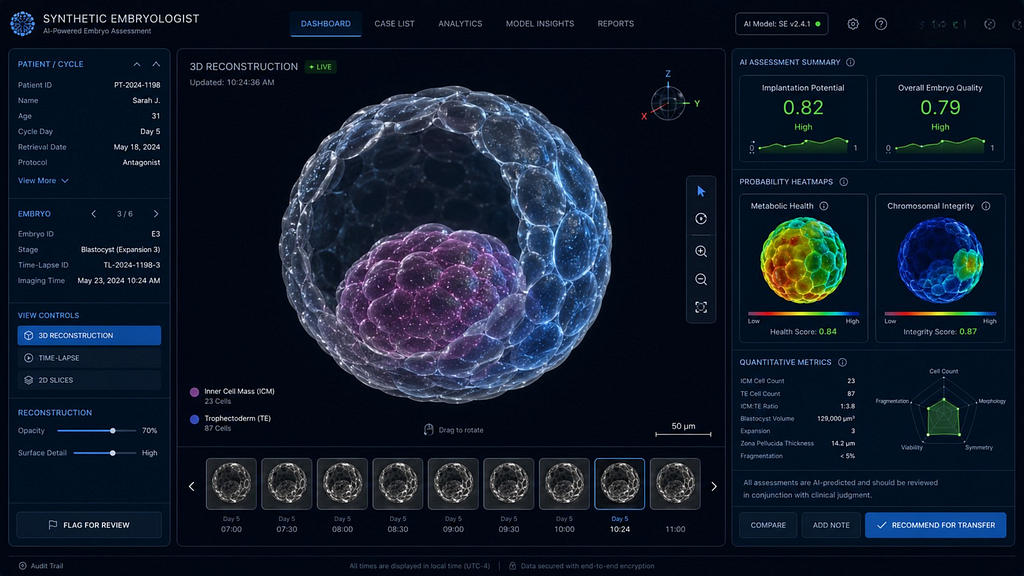
• Automated Annotators: These systems act as a “Digital Twin” for every embryo, recording thousands of data points, from the exact micro-moment of pronuclear fading to the sub-second kinetics of blastocyst expansion, with a granularity far beyond human capability.
Evidence Summary
New systematic reviews in Frontiers in Assisted Reproduction (May 2026) and recent discourse in Human Reproduction highlight a transformative trend:
• Predictive Power: AI models are achieving a median accuracy of 81.5% in predicting clinical pregnancy when integrating image-based kinetics with patient history.
• Risk Mitigation: Early adopters report a near-zero incidence of “mismatch” events.
• Efficiency: A 30% to 50% reduction in embryologist administrative workload. By removing the cognitive burden of repetitive verification, specialists can redirect their focus toward high-precision manual interventions like ICSI and biopsy.
The AI Workflow
1. Continuous Surveillance: Computer vision monitors all workstation movements, identifying specific culture dishes and gamete samples in real-time.
2. Automated Annotation: The AI timestamps key developmental milestones (e.g., $t2, t5, tB$) without human intervention.
3. Conflict Detection: Instant alerts are triggered if the system detects an ID mismatch or an unexpected developmental anomaly.
4. Audit Trail Generation: An unalterable digital “life story” of the embryo is generated, providing clinicians with a robust data set to support the final transfer decision.
Limitations & Bias
The primary challenge identified in the May 2026 ethical reviews is the “Explicability Gap.” As algorithms gain complexity, explaining a “low viability” score to a patient becomes difficult if the AI cannot visualise the specific biological reasoning. Furthermore, there is growing concern about “Algorithm Paternalism”, in which AI recommendations might override clinical intuition without a transparent “Reasoning Layer.”
Practice Takeaway: Shift from ‘Selection’ to ‘Standardisation’
While AI is often marketed as a tool to “pick the winner,” its immediate value lies in protecting the process.
Clinical Pearl: Implementing AI-driven witnessing reduces human error and provides a data-backed defence for your clinical decisions. In your next lab audit, consider how transitioning to automated “Witnessing” can improve safety metrics while liberating your embryology team to focus on the art of precision medicine.
How are your patients currently reacting to the mention of AI in their treatment plan, with optimism or “black box” scepticism? Let us know.
References
1. New principles for the use of artificial intelligence in human reproduction: leave everything as it is? Human Reproduction, May 13, 2026.
2. The integration of artificial intelligence in assisted reproduction: a comprehensive review. Frontiers in Reproductive Health, May 2026.
3. Embryo selection through artificial intelligence versus embryologists: a systematic review. Human Reproduction Open, 2026 Update.
For Clinicians: Stay at the forefront of reproductive science. Join our digital health collaborative to access real-time AI-driven benchmarks and advanced dose-prediction tools.
👉 Contact our Clinical Relations Team
https://www.google.com/search?q=https://www.santaan.in/contact-centres
Technical Metadata