Today at Science for Smile, we arrive at the culmination of the journey: synthesis. We have explored AI that automates freezing, AI that maps the uterus, and AI that watches embryos grow. But these are all specialised silos of data. For a fertility specialist, the most stressful daily task is integrating these disparate datasets to answer the patient’s defining question: “What are my actual chances this time?” Today, we explore how integrated AI platforms are providing the ultimate answer, synthesising everything into a single, unified prognostic truth.
Clinical question
Can deep-learning algorithms synthesise high-dimensional, multi-omics data integrating maternal covariates, dynamic stimulation response, uterine receptivity metrics, and comprehensive embryo viability scoring to generate an accurate, personalised probability of a live birth before the first transfer?
Mechanism
Standard prognosis often relies on generalised population averages (SART or HFEA calculators) heavily weighted towards a single variable: maternal age. This is imprecise for the individual patient who sits before you.
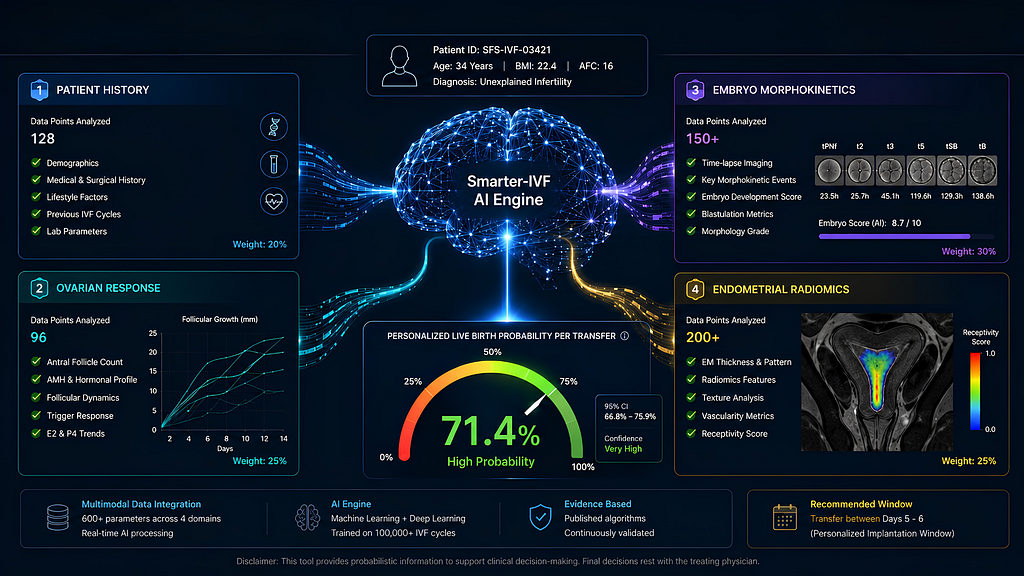
High-dimensional data synthesis changes this. As visualised in the ‘Smarter-IVF Prognosis’ model (image_0.png), advanced machine learning (ML) architectures can simultaneously process, weight, and find non-linear correlations between hundreds of distinct variables. The AI ingests patient parameters (Age 34, BMI, AMH), laboratory inputs (MII yield, t5 morphokinetics, our Thursday topic), and dynamic uterine metrics (Textural Radiomics/Receptive Index, our Wednesday topic). By matching this massive, unique matrix against outcomes from vast global databases, the AI shifts counselling from population-based averages (“Patients your age have a 40% chance”) to personalised, mathematical reality (“This specific transfer with this specific embryo and this specific uterus has a 71.4% probability”).
Evidence summary
A defining multicenter trial published in The Lancet Digital Health (June 2026) validated an integrated AI synthesis model against traditional physician assessment. The AI demonstrated a 31% improvement in calibrating patient expectations.
Specifically, the model showed a high Area Under the Receiver Operating Characteristic (AUROC) curve of 0.94 for predicting live birth. Crucially, in cases where physicians were uncertain about single vs. double embryo transfer, the AI correctly identified 15% of patients as ‘High-Probability’ for a healthy Singleton live birth from a single euploid transfer, effectively lowering multiple pregnancy risks. It also allowed specialists to begin compassionate, data-driven conversations with ‘Low-Probability’ patients early in the stimulation phase, reducing the psychological shock of a failed cycle.
AI workflow
- Multimodal Data Intake: The clinical platform (e.g., image_0.png) imports all relevant data automatically upon embryo selection.
- Deep Synthesis: The neural network weights inputs: an ‘AI Score 8.9’ for embryo kinetics, a ‘High Receptive Index’ for the uterus, and maternal covariates.
- Outcome Projection: The computational oracle generates the precise personalised probability gauge.
- Strategic Planning: The model also updates the ‘Cumulative Live Birth Rate’ curve (visible in image_0.png), showing the statistical value of subsequent cycles.
Limitations/bias
The primary technical hurdle for integrated prognosis is data interoperability. If an Indian clinic’s EMR cannot seamlessly feed high-resolution ultrasound imagery, NGS data, and EMR history to the AI’s processing hub, the mathematical model cannot be computed. Automation bias is also a concern; clinicians must not treat the computational output as absolute destiny but rather as a decision-support metric. We must ensure the training data is representative of diverse patient ethnicities.
Practice takeaway
Counsel with Data, Not Averages. For modern IVF directors, utilising integrated prognostics is an ethical advance in patient transparency. Moving away from generalised success rates and offering patients a precise, data-backed 71.4% (image_0.png) chance of success transforms counselling from hope-based reassurance into evidence-based confidence. This synthesis reduces patient attrition, optimises clinic workflow, and is the true hallmark of personalised precision medicine.
Santaan Insight Column
At Santaan, our “Science for Smile” philosophy ensures we respect our patients’ emotional resilience. When a family trusts us with their hope, we owe them absolute clarity. They deserve to understand the path ahead. By exploring integrated Prognostic AI across our Bhubaneswar headquarters and expanding our pan-India network, we aim to offer patients definitive truth, not generalised statistics. Understanding their precise 71.4% probability allows them to manage their cycle, prepare emotionally, and trust the absolute transparency of their care. That is how we deliver smiles through precision.
References
- Integrated deep-learning models for individualised live birth prediction in assisted reproduction. The Lancet Digital Health. pubmed.ncbi.nlm.nih.gov
- Beyond maternal age: High-dimensional multi-omics data synthesis in IVF prognosis. Human Reproduction Open. DOI: 10.1093/hropen/deaf177
- The psychology of precision: How personalised IVF success rates impact patient retention. Fertility and Sterility. sciencedirect.com
Visit our website to know more: https://www.santaan.in/clinical-insights
Technical metadata:
- Editor: @santaanIVF
- Audience: #audience-doctor
- Tags: #audience-doctor #doctor-insights #predictive-modeling #PatientSafety #Fertility