
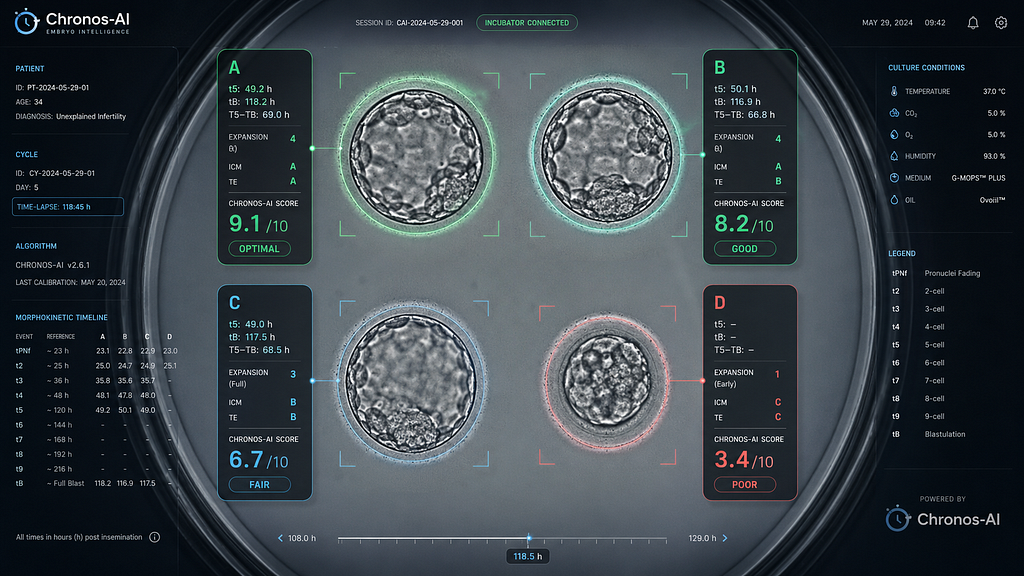
This week at Science for Smile, we have journeyed through automated freezing, precise transfer navigation, and non-invasive uterine analysis. Today, we enter the absolute core of the embryology laboratory to address the single most impactful decision of the cycle: which embryo to transfer first. Static grading has served us for decades, but it only tells a fraction of the story. We explore how deep-learning algorithms, observing life unfold in real-time, are revolutionising embryo selection.
Clinical question
Does the integration of deep-learning Convolutional Neural Networks (CNNs) with Time-Lapse Imaging (TLI) data provide a superior predictive capability for clinical pregnancy and live birth compared to standardised manual morphology grading (Gardner criteria)?
Mechanism
Standard embryo grading involves removing the embryo from the safe microenvironment of the incubator to observe its appearance at specific, static time points (snapshots). This method is highly subjective, with significant inter- and intra-observer variability, and misses vital kinetic information.
Time-Lapse Imaging monitors embryos continuously within an undisturbed, controlled environment. Humans are visually overwhelmed by the thousands of images generated. The newest ‘Chronos-AI’ platforms employ deep learning to analyse the full 4D dataset (3D space + time). The algorithm segments images to calculate precise morphokinetic markers, exactly when specific cellular cleavages (t2, t3, t5) and cavitation occur. The AI correlates these microscopic temporal shifts against massive, outcome-linked databases to generate a ‘Viability Score’ (0–10) in real-time, predicting the absolute statistical probability of implantation for each specific embryo.
Evidence summary
A comprehensive 2026 meta-analysis published in Fertility and Sterility synthesised data from eight global randomised controlled trials. The results were compelling. AI-driven morphokinetic ranking, when applied to unbiopsied, Day 5 blastocysts, demonstrated an Area Under the Receiver Operating Characteristic curve (AUROC) of 0.93 for predicting ongoing pregnancy — vastly outperforming traditional manual grading (AUROC of 0.71). The studies confirmed that dynamic AI algorithms are far more adept than humans at identifying “fair” embryos that are actually highly viable, and “good” embryos with underlying kinetic flaws that will lead to implantation failure.
AI workflow
- Undisturbed Culturing: Embryos are cultured for 5–6 days in specialised time-lapse incubators with integrated high-resolution cameras.
- Dynamic Data Capture: The incubator captures images every 5–10 minutes across multiple focal planes, generating a continuous “movie” of development.
- Automated Morphokinetics: The AI algorithm automatically reads the visual data, identifying and timestamping key developmental milestones without any manual human input.
- Predictive Ranking: The laboratory dashboard ranks the entire cohort based on their computed Viability Score, assisting the embryologist in selecting the single best embryo for immediate transfer or freezing.
Limitations/bias
The primary limitation is data generalizability. AI models trained on specific time-lapse hardware, culture media, and laboratory conditions do not always translate perfectly to a different lab environment. Furthermore, like all AI, it is vulnerable to biased training data; if the algorithm was trained primarily on young oocyte donors, its predictive performance may degrade when applied to complex cases of advanced maternal age. To mitigate this, labs must prioritise AI platforms validated on diverse patient populations.
Practice takeaway
Move from Snapshot to Cinema. For modern Indian IVF centres managing large cohorts, time-lapse incubation combined with AI selection is no longer a luxury; it is an ethical imperative for optimising efficiency. This technology shifts our strategy from subjective “embryo grading” to mathematical “embryo ranking.” By using morphokinetics to identify the single embryo most likely to produce a healthy baby on the first transfer, we significantly shorten the overall time-to-pregnancy, reduce operational stress in the lab, and lower the emotional and financial burden on our patients.
Santaan Insight Column
At Santaan, our “Science for Smile” ethos drives us to seek technologies that minimise patient uncertainty constantly. We know that every failed transfer is a heartbreak. By integrating automated time-lapse analysis into our incubators across our clinics in Bhubaneswar and pan-India, we are removing the “guesswork” that can happen during busy laboratory shifts. Letting AI see the subtle life-signs that are invisible to the human eye allows us to honour our patients’ investment, delivering their most viable embryo first time, every time.
References
- AI-driven morphokinetic analysis of time-lapse images improves embryo selection: a systematic review and meta-analysis. Fertility and Sterility. pubmed.ncbi.nlm.nih.gov
- Standardising embryo selection: The validation of deep-learning models in the modern lab. Human Reproduction Open. DOI: 10.1093/hropen/deaf155
- Undisturbed culture and automated analysis: Time-lapse incubation and the future of embryology. Reproductive BioMedicine Online. sciencedirect.com
Technical metadata:
- Editor: @santaanIVF
- Audience: #audience-doctor
- Tags: #audience-doctor #doctor-insights #predictive-modeling #PatientSafety #Fertility