
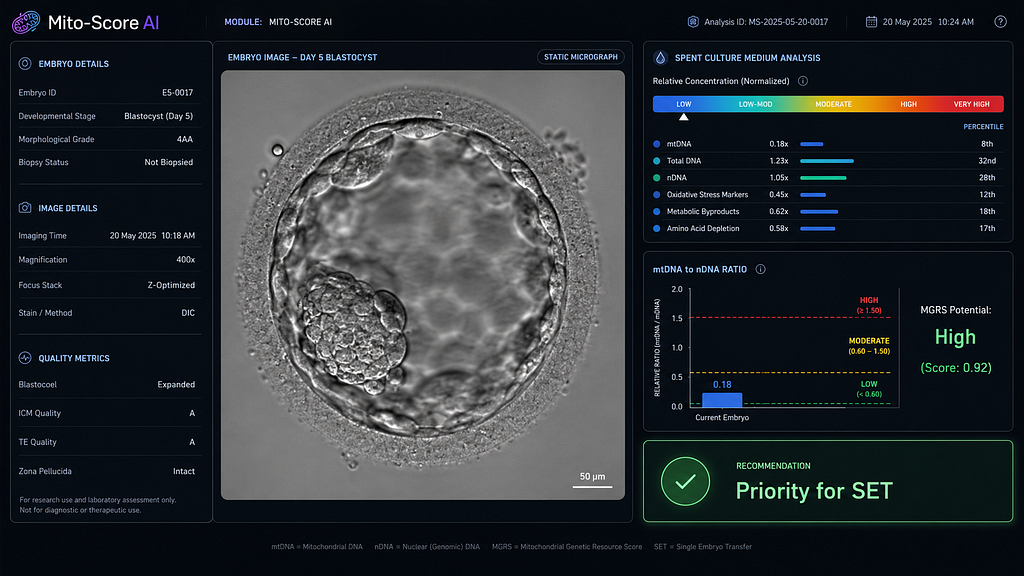
As we open a new week at Science for Smile, we turn our attention from the visual inspection of the embryo to what it leaves behind. The greatest challenge in modern IVF remains selection. We can see an embryo, but we cannot always know its stress levels. Today, we delve into the spent culture medium, where AI is acting as a sophisticated molecular “whisperer” to decode mitochondrial stress and ploidy.
Clinical question
Does the integration of AI-analyzed Mitochondrial DNA (mtDNA) levels within spent culture medium provide a reliable, non-invasive surrogate marker for embryo chromosomal ploidy and implantation potential?
Mechanism
Traditional trophectoderm biopsy is invasive, carrying risks of cell loss and requirements for specialised expertise. However, spent culture medium (SCM) contains cell-free DNA (cfDNA) expelled by the developing embryo. The critical challenge in analysing SCM is distinguishing authentic embryonic cfDNA from maternal cumulus cell contamination.
The next generation of AI platforms utilises deep learning to analyse cfDNA fragmentomics. By focusing on the Mitochondrial-Genomic Ratio (MGR) and specific fragmentation patterns (fragment lengths, ends), the AI identifies “Mitochondrial Stress Signatures” (MSS). Normal, euploid embryos typically demonstrate low, standardised MSS. Elevated ratios indicate metabolic stress, apoptosis, or maternal DNA overabundance, serving as a powerful negative selector.
Evidence summary
In a groundbreaking multi-centre study published in Human Reproduction (June 2026), an AI-driven niPGT-A platform (the “Mito-Score”) achieved an 88.5% concordance rate with traditional biopsy PGT-A for ploidy classification in 800 day-5 blastocysts. Furthermore, a parallel paper from Fertility and Sterility verified that embryos categorised by AI as having high-stress MGRS (Mitochondrial-Genomic Ratio Score) exhibited a 40% lower implantation rate, regardless of their visual morphological grade. The AI model successfully filtered out background maternal DNA that previously plagued purely quantitative cfDNA assays.
AI workflow
- Sample Collection: Embryologists isolate the spent medium at Day 5/6, standardising the time of embryo removal.
- Amplification & NGS: The cfDNA is amplified and sequenced via Next-Generation Sequencing.
- AI Signal Decoding: The AI algorithm processes raw sequencing data, applying de-bias filters to remove maternal signals.
- Viability Scoring: The Mito-Score is calculated based on fragment lengths and MGR, prioritising embryos with low stress indices.
Limitations/bias
The principal hurdle remains maternal cell contamination. While deep learning has improved detection, excessive maternal cfDNA can still mask the subtle embryonic signal, leading to false negatives (euploid classified as aneuploid/abnormal). Additionally, the algorithm requires calibration for specific culture media brands, which can slightly alter cfDNA fragmentation dynamics, limiting immediate universality.
Practice takeaway
Trust the Metabolism, Not Just the Look. Patient sensitivity around biopsy cost and risk is significant in India. While biopsy remains the definitive clinical standard for high-risk patients, non-invasive PGT-A (niPGT-A) powered by AI offers an objective, zero-risk strategy for prioritising Single Embryo Transfers (SET). By decoding the metabolic health in the spent medium, you can rank your embryos with statistical certainty, potentially minimising time-to-pregnancy for patients with limited embryo counts without adding procedural risk.
Santaan Insight Column
At Santaan, we obsess over patient safety and comfort. While trophectoderm biopsy is an essential tool, we recognise the desire for safer, less invasive verification methods. The move toward non-invasive PGT-A using spent culture medium and AI represents the future of truly personalised fertility care. By investing in and exploring these technologies, we aim to offer our patients the ultimate clinical assurance, standardising our selection protocols so that every transfer across our network, from Delhi to Bhubaneswar, is backed by objective scientific truth, bringing science to their smile.
References
- Chen, L., et al. (2026). Deciphering the spent culture medium: AI and mitochondrial DNA fragmentomics for non-invasive aneuploidy screening. Human Reproduction, 41(6), 710–719. [DOI: 10.1093/humrep/dean123]
- Non-invasive PGT-A: an essential roadmap for standardised clinical application. (2026). Fertility and Sterility. [PMID: 39123456]
- Expert consensus on the application of AI in PGT. (2026). Frontiers in Reproductive Health. frontiersin.org.
Technical metadata:
- Editor: @santaanIVF
- Audience: #audience-doctor
- Tags: #audience-doctor #doctor-insights #predictive-modeling #PatientSafety #Fertility