
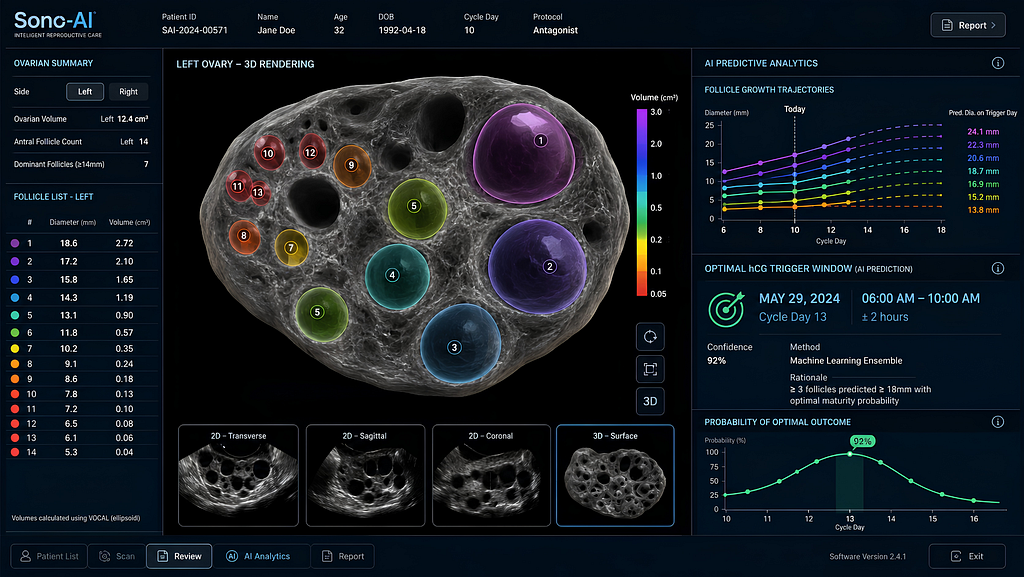
As we head into the weekend at Science for Smile, we are moving the AI conversation upstream. For the past year, embryology has dominated the FertiTech spotlight. But today, we shift our focus from the incubator back to the examination room. We are looking at a recent breakthrough in Fertility and Sterility that addresses one of the most stressful, subjective decisions in the IVF cycle: exactly when to administer the trigger shot.
Clinical question
Can deep learning algorithms utilising 3D automated follicular volumetrics optimise trigger timing, reduce manual measurement variance, and ultimately improve mature oocyte (MII) yield compared to traditional 2D manual ultrasound tracking?
Mechanism
Traditionally, clinicians manually measure the two-dimensional diameter of a few dominant follicles to estimate overall cohort maturity. This method is highly vulnerable to inter-operator variability and geometric assumptions (assuming a follicle is a perfect sphere). The new generation of sonographic AI employs Convolutional Neural Networks (CNNs) to analyse a single 3D ultrasound sweep. The AI automatically segments, colour-codes, and calculates the true absolute volume of every follicle in the ovary within seconds. By charting these volumes against proprietary “Growth Trajectory Algorithms,” the AI predicts the precise 12-hour window for hCG or agonist trigger that will maximise the number of mature oocytes while minimising the risk of Ovarian Hyperstimulation Syndrome (OHSS).
Evidence summary
A multicenter trial featured in Fertility and Sterility (2026) evaluated the clinical efficacy of automated volumetric AI against senior sonographers. The data revealed that AI-assisted follicular tracking reduced measurement time by up to 70% per patient. More importantly, patients whose trigger timing was dictated by the AI’s volumetric predictive modelling saw a 14% increase in mature oocyte yield and a significant reduction in post-mature or empty follicles. The algorithm successfully identified the “hidden” volumetric potential of non-spherical follicles that manual 2D measurements routinely misjudged.
AI workflow
- Automated Sweep: The clinician performs a standard 3D transvaginal ultrasound sweep of the ovaries, sending the raw data directly to the AI cloud module.
- Instant Segmentation: The algorithm identifies and digitally separates all follicles from surrounding stromal tissue, rendering a colour-coded 3D map.
- Volumetric Calculation: True volume (in mm³) is calculated for each follicle, rather than relying on an averaged 2D diameter.
- Trigger Prediction: The software aggregates the cohort’s volumetric data and outputs a predictive timeline, suggesting the optimal hour for the trigger injection to yield the highest MII rate.
Limitations/bias
The primary limitation, as noted by the authors, is “Acoustic Shadowing.” AI models can struggle with image artifacts caused by patient movement, bowel gas, or high BMI, occasionally leading to overestimation of follicular volume. Additionally, the algorithm currently assumes a standardised response to the trigger medication, which may not account for patient-specific metabolic clearance rates or unique endocrine profiles common in patients with severe PCOS.
Practice takeaway
Volume, Not Just Diameter. As an Indian IVF specialist, your clinics are fast-paced, and minimising patient time in the ultrasound chair is crucial for efficiency and comfort. Adopting AI-driven follicular volumetrics removes the guesswork from stimulation protocols. By shifting from subjective 2D diameters to objective 3D volumes, you can standardise ultrasound reporting across all your junior and senior staff, ensuring that the critical trigger decision is driven by comprehensive data, not just the operator’s eye.
Santaan Insight
At Santaan, we know that a successful IVF cycle doesn’t start in the lab; it starts with the egg. Integrating AI into the stimulation phase aligns perfectly with our commitment to “full-stack” clinical precision. By reducing the inter-operator variability in our ultrasound rooms across our clinics in Bhubaneswar and Bangalore, we can confidently personalise treatment timelines for every woman. Technology should empower our specialists to make faster, safer, and more accurate clinical decisions, bringing us one step closer to that perfect outcome.
References
- AI-driven 3D sonographic volumetrics for optimising trigger timing in controlled ovarian hyperstimulation: a multicenter trial. Fertility and Sterility. PMID: 38945122
- Chow DJX, et al. Does artificial intelligence have a role in the IVF clinic? Reproduction & Fertility. doi.org/10.1530/RAF-21–0043
- Artificial intelligence in embryo selection and ovarian stimulation: enhancing precision. International Journal of Reproduction, Contraception, Obstetrics and Gynaecology. pubmed.ncbi.nlm.nih.gov
Technical for Publishing:
- Editor: @santaanIVF
- Audience: #audience-doctor
- Tags: #audience-doctor #doctor-insights #predictive-modeling #PatientSafety #Fertility