
The End of the Manual Scan? How AI is Automating Follicle Tracking and Standardising Ovarian Monitoring
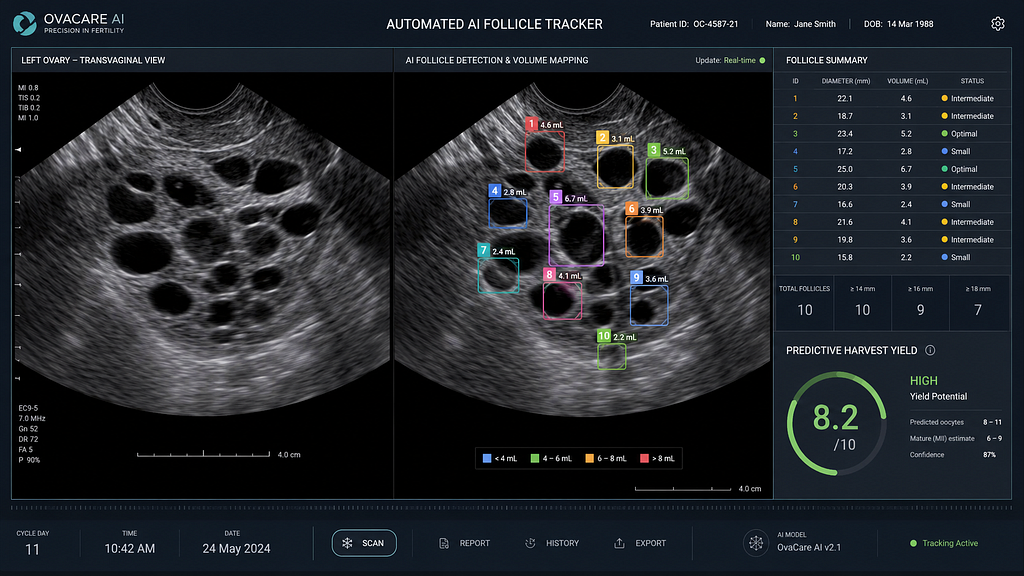
Welcome to Science for Smile, where we curate the cutting edge of reproductive medicine for the modern clinician. We spend a tremendous amount of time discussing the precision of the embryology lab, but what about the precision of our monitoring? Today, we explore how AI is finally solving one of our most time-consuming and subjective clinical bottlenecks: the manual ultrasound follicle count.
Clinical question
Can an artificial intelligence platform automate the measurement and count estimation of ovarian follicles from standard 2D ultrasounds with precision and reliability equal to or greater than certified expert sonographers?
Mechanism
In standard controlled ovarian stimulation (COS), measuring follicular growth is critical for timing the trigger shot and preventing OHSS. However, manual 2D ultrasound measurement is inherently subjective, dependent on the angle, the operator, and clinical fatigue.
Enter Computer-Assisted Image Processing via Convolutional Neural Networks (CNNs). The newest AI platforms utilise “bounding-box” algorithms trained on thousands of scans. The AI instantly segments the ovary, identifies every visible fluid-filled structure, and calculates the two-dimensional diameter and estimated volume of each follicle in milliseconds. It effectively eliminates intra- and inter-operator variability, acting as an objective, tireless “digital sonographer.”
Evidence summary
A pivotal 2026 multicenter study published recently highlights the immense utility of these automated platforms. Analysing thousands of TVUS scans from patients undergoing COS across multiple global centres, the AI model evaluated follicle counts and size measurements against expert annotations.
The AI achieved a remarkable 98.2% precision and a 93.3% F1 score for clinically significant follicles (≥ 10 mm). Beyond accuracy, the most striking finding was clinical efficiency: the AI-assisted annotation reduced the time required for a follicle scan by 2.5-fold (p < 0.01), requiring fewer than 0.6 manual adjustments per scan by the reviewing physician. Crucially, the model’s performance remained stable across different brands of ultrasound machines.
AI workflow
- Standard Image Capture: The clinician performs a routine transvaginal ultrasound, pausing briefly to let the software capture the necessary frames.
- Instant Segmentation: The deep learning model identifies the ovarian boundaries and places bounding boxes around all visible follicles.
- Automated Calculation: The system instantly calculates the dimensions of each follicle, colour-coding them by size cohort (e.g., <10mm, 10–14mm, >15mm).
- Clinical Review: The specialist reviews the AI-generated report on the screen, accepts or slightly adjusts the findings, and uses the standardised data to finalise the daily gonadotropin dose.
Limitations/bias
While the AI performs exceptionally well on distinct, rounded follicles, challenges remain with overlapping follicles or highly cystic ovaries (such as in severe PCOS), where the algorithm may struggle to delineate boundaries accurately. Furthermore, while the model is stable across different ultrasound platforms, older machines with poor resolution and high acoustic shadowing can significantly degrade the AI’s precision, necessitating a baseline level of modern clinical hardware.
Practice takeaway
Save time and eliminate subjectivity. For Indian IVF specialists managing high patient volumes, time is one of our most precious commodities. Manual follicle tracking is tedious and prone to human error, especially at the end of a long clinical day. By integrating AI-automated follicle tracking, you not only reclaim minutes on every single scan, but you also ensure that your trigger criteria are based on standardised, objective data. This scalable technology allows you to handle higher patient loads without ever compromising the quality or safety of your care.
Santaan Insight
At Santaan, we recognise that true innovation must directly improve both the patient outcome and the physician’s daily workflow. Across our clinics in Bhubaneswar and Bengaluru, we are evaluating automated AI follicle tracking systems to streamline our morning monitoring sessions. By removing the subjectivity from ultrasound measurements, we empower our doctors to make faster, more confident clinical decisions regarding stimulation and trigger timing. This commitment to AI-assisted monitoring ensures that our patients experience shorter wait times, highly precise care, and a smoother, safer journey to parenthood.
References
- An artificial intelligence platform for automated measurement and count estimation of ovarian follicles during ovarian stimulation and IVF: a multicenter study. Reproductive Medicine, 2026. PMID: 41485151
- Enhanced predictive performance of artificial intelligence in individualised ovarian stimulation of in vitro fertilisation: a retrospective cohort study. PubMed, 2026. PMID: 41808171
Technical Checklist for Publish:
- Editor: @santaanIVF
- Audience: audience-doctor
- Tags: #audience-doctor #doctor-insights #predictive-modeling #PatientSafety #Fertility #AIinIVF #OvarianStimulation #FertiTech