Today at Science for Smile, we turn our attention to the democratisation of FertiTech. Today’s focus highlights a critical paper from Frontiers in Artificial Intelligence, challenging the assumption that predictive modelling in the lab requires ripping out your existing infrastructure. We are moving away from the absolute reliance on expensive time-lapse cinematography and exploring how Transfer Learning is turning standard benchtop microscopy into a predictive powerhouse.
Clinical question
Can non-invasive AI algorithms utilising only a few static optical images accurately predict clinical pregnancy outcomes without requiring continuous time-lapse incubators?
Mechanism
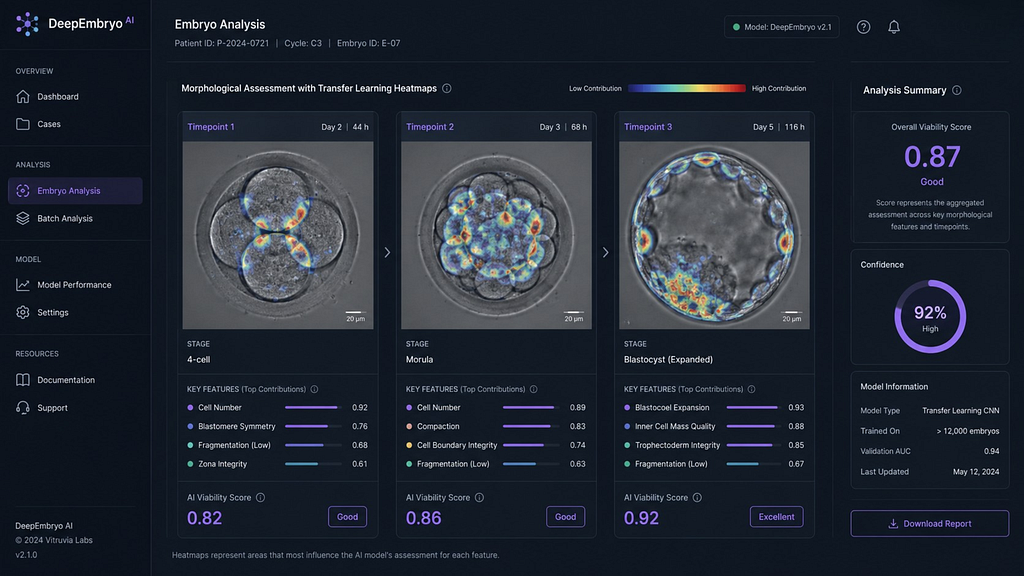
Traditionally, the most robust AI models for embryo selection have relied heavily on continuous time-lapse imaging to detect non-linear morphokinetic signatures. However, the DeepEmbryo algorithm leverages a deep learning architecture known as Transfer Learning. Instead of requiring millions of continuous video frames, the neural network is pre-trained on vast, generalised image datasets. It is then fine-tuned to recognise subtle structural viability markers across just three standard static images taken at specific intervals post-insemination. This allows the AI to extract high-level predictive features from standard microscopy, entirely bypassing the need for kinetic video analysis.
Evidence summary
Recent findings published in Frontiers in Artificial Intelligence demonstrate that AI doesn’t always need video to significantly augment human visual grading. The study introduced an automated segmentation and assessment algorithm designed to predict clinical pregnancy outcomes using static images. By employing transfer learning to overcome the limitations of small, clinic-specific IVF datasets, the model achieved predictive accuracies that heavily rival traditional time-lapse systems. Crucially, it integrates directly into existing IVF lab processes without demanding new hardware or disrupting the embryologist’s established workflow.
AI workflow
- Data Acquisition: The embryologist captures three standard static images using an optical light microscope at standardised times post-insemination.
- Automated Segmentation: The AI autonomously isolates the embryo from the background, standardising the visual field and removing optical noise.
- Feature Extraction: Using transfer learning, the model analyses the static frames for complex morphological patterns associated with successful implantation that the human eye might miss.
- Viability Scoring: The system outputs a clinical pregnancy prediction score, offering a standardised, objective second opinion before transfer.
Limitations/bias
The primary limitation of static-image AI models is “Generalisation Drop.” Because static images vary drastically based on lighting, microscope optics, and focal depth across different clinics, the AI may experience a reduction in accuracy when deployed outside its native training environment. Additionally, static imaging inherently misses kinetic anomalies such as reverse cleavage or abnormal division timings that time-lapse systems are specifically designed to catch.
Practice takeaway
High-Tech Doesn’t Necessarily Mean High-Cost. For Indian IVF specialists, equipping every laboratory with time-lapse incubators is often a prohibitive capital expense, especially in tier-2 cities. Algorithms relying on transfer learning highlight a shift toward accessible predictive modelling. By maximising the data extracted from standard static images, clinics can integrate objective AI decision-support tools, elevating the standard of care without passing exorbitant hardware costs onto the patient.
Santaan Insight
At Santaan, we recognise that true innovation in FertiTech must be scalable. While time-lapse AI models are incredible research tools, the reality of the Indian healthcare landscape demands accessible excellence. By investigating AI integration methods that work with our existing laboratory setups, we ensure that predictive analytics enhance patient safety and success rates across all clinic locations, not just the metropolitan hubs. True clinical AI shouldn’t just be intelligent; it must be implementable.
References
- An artificial intelligence algorithm to select the most viable embryos considering the current process in IVF labs. Frontiers in Artificial Intelligence. DOI: 10.3389/frai.2024.1375474
- Kragh, M. F., & Karstoft, H. Embryo selection with artificial intelligence: how to evaluate and compare methods? Journal of Assisted Reproduction and Genetics. pubmed.ncbi.nlm.nih.gov
- Artificial Intelligence in Routine IVF Practice: A Roadmap for Responsible Adoption. Frontiers in Reproductive Health. frontiersin.org
Technical Checklist:
- Editor: @santaanIVF
- Audience: #audience-doctor
- Tags: #audience-doctor #doctor-insights #predictive-modeling #PatientSafety #Fertility