
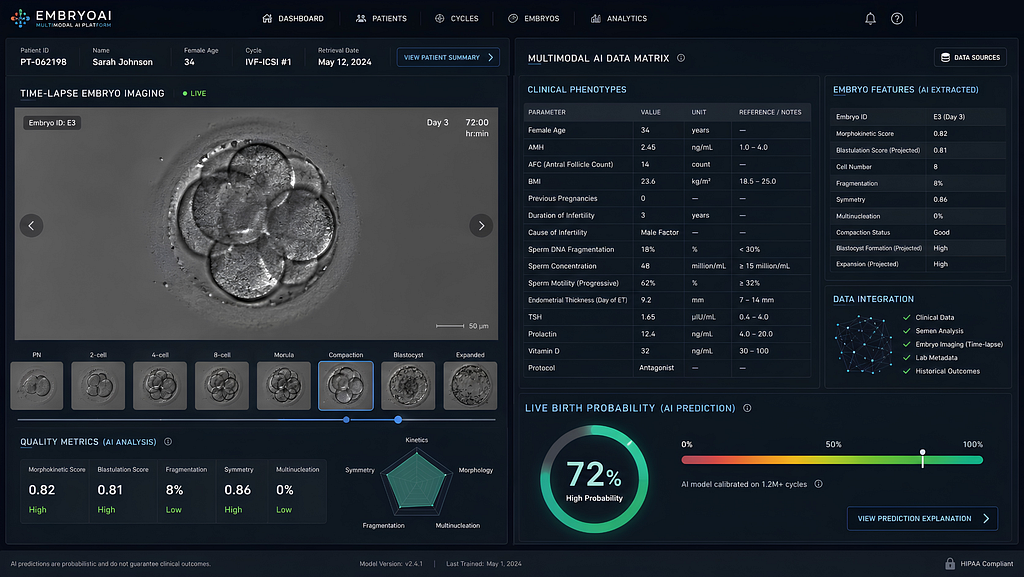
Welcome back to Science for Smile, where we curate the most impactful research in reproductive medicine. Over the past week, we have explored AI’s mastery of the embryo, the endometrium, and the sperm. But an embryo does not exist in a vacuum. Today, we address the next logical evolution in FertiTech: breaking down the silos between the clinical consult room and the embryology lab to predict actual live births.
Clinical question
Does combining clinical phenotype data (using machine learning) with embryo time-lapse imaging (using deep learning) improve the prediction of actual live births compared to AI models that analyse embryo morphokinetics alone?
Mechanism
Early AI models in IVF functioned almost exclusively as image analysers. A Convolutional Neural Network (CNN) would evaluate time-lapse videos of a blastocyst and predict its competence based purely on visual developmental milestones. However, a morphologically “perfect” embryo may still fail if placed in a suboptimal clinical environment. The next generation of “Multimodal AI” bridges this gap. These platforms use a Support Vector Machine (SVM) to process high-dimensional baseline clinical data (e.g., maternal age, AMH, BMI, and sperm parameters). The algorithm then mathematically fuses this clinical phenotype with the CNN’s time-lapse morphokinetic assessment. This creates a holistic predictive model that calculates success by factoring in both the seed (the embryo) and the system (the patient).
Evidence summary
A pivotal 2026 study published in Medicina highlights the absolute necessity of this multimodal approach. Researchers developed an AI tool that successfully integrated a clinical SVM with an imaging CNN. By testing this combined architecture against isolated image-only models, the multimodal system demonstrated a significantly higher accuracy in predicting true Live Birth outcomes, not just implantation events. The data underscores that clinical variables dynamically alter how we should interpret embryo morphokinetics. When AI is permitted to analyse both datasets simultaneously, the algorithm accurately stratifies patients, providing a realistic prognosis that prevents the heartbreak of transferring a highly-graded embryo into a clinically mismatched environment.
AI workflow
- Clinical Data Ingestion: Patient baseline characteristics (age, ovarian reserve, spousal BMI, infertility duration) are seamlessly uploaded from the Electronic Health Record (EHR) into the AI’s Support Vector Machine.
- Kinematic Analysis: Simultaneously, the CNN evaluates the continuous time-lapse video of the embryo’s development, extracting hidden kinetic features.
- Multimodal Fusion: The AI algorithm merges the clinical phenotype matrix with the embryo’s morphokinetic score.
- Live Birth Prediction: The system outputs a personalised “Live Birth Probability” percentage, equipping the specialist with a comprehensive decision-support tool for Single Embryo Transfer (SET).
Limitations/bias
The primary limitation of multimodal AI is the absolute requirement for pristine, standardised data entry across both clinical and laboratory systems. If your EHR contains missing or miscoded clinical variables, the SVM’s predictive power degrades rapidly. Furthermore, these models can suffer from “Dataset Drift” if trained exclusively on specific global demographics. For the algorithm to remain clinically actionable, it must be locally validated against the specific clinical phenotypes and metabolic baselines prevalent in the Indian patient population.
Practice takeaway
Treat the couple, not just the cohort. For Indian IVF specialists, selecting the best embryo is only half the equation; understanding the clinical context of the transfer is the other. By adopting Multimodal AI platforms that integrate patient phenotypes with lab imaging, you move beyond isolated embryology and into true holistic, preventive care. As you upgrade your clinic’s software architecture, demand true integration to ensure your time-lapse AI can talk directly to your clinical records to generate a unified, highly accurate Live Birth prediction.
Santaan Insight
At Santaan, we believe that true predictive medicine requires breaking down the walls between the clinic and the laboratory. Our teams across Bhubaneswar, Delhi, and Bengaluru are championing this multimodal approach, mirroring our commitment to full-stack prevention and holistic care. We recognise that an embryo’s potential is deeply intertwined with the parents’ underlying clinical health. By investing in AI architectures that fuse high-dimensional clinical phenotypes with advanced time-lapse imaging, we empower our doctors to see the complete picture. This data-driven, integrated approach ensures that every transfer decision is grounded in the reality of the patient’s unique biology, maximising safety and driving higher success rates.
References
- Pregnancy AI: Development and Internal Validation of an Artificial Intelligence Tool to Predict Live Births in ICSI and IVF Cycles Using Clinical Features and Embryo Images. Medicina, 62(2), 2026. DOI: 10.3390/medicina62020364
- Current applications of artificial intelligence in assisted reproductive technologies. Minerva Obstetrics and Gynaecology, 78(2), 148–158, April 2026. DOI: 10.23736/S2724–606X.25.05754–9
- A Systematic Review on The Role of Artificial Intelligence in Assisted Reproductive Technology. International Journal of Bioinformatics and Computational Biology, 04(01), 2026.
Technical Checklist for Publish:
- Editor: @santaanIVF
- Audience: audience-doctor
- Tags: #audience-doctor #doctor-insights #predictive-modeling #PatientSafety #Fertility #AIinIVF #MultimodalAI #DigitalHealth