
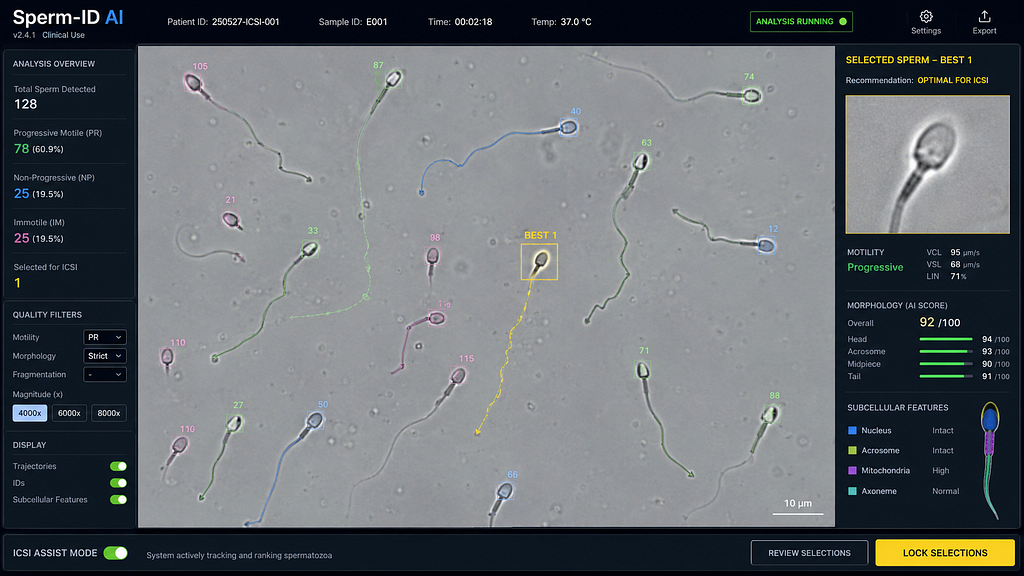
As we continue our week at Science for Smile, we pivot to an often-overlooked frontier in FertiTech: Andrology. While embryo evaluation has largely dominated the AI conversation, male factor infertility accounts for up to half of all IVF cases. Today, we examine how real-time computer vision is removing the subjectivity from the most delicate, high-stakes procedure in the laboratory: selecting the single perfect sperm for Intracytoplasmic Sperm Injection (ICSI).
Clinical question
Can real-time, AI-driven computer vision algorithms accurately assess the morphology and motility of unstained, live spermatozoa during the ICSI procedure to improve blastocyst formation and euploidy rates compared to subjective human embryologist selection?
Mechanism
In traditional ICSI, the embryologist must visually scan a rapidly moving sample under high magnification to select a single sperm based on subjective visual criteria. Because live sperm for ICSI cannot be fixed or stained, subtle morphological defects are easily missed.
The latest generation of AI-assisted single-sperm selection tools utilises deep Convolutional Neural Networks (CNNs) directly integrated into the microscope’s camera feed. Operating in milliseconds, the AI tracks thousands of moving sperm simultaneously. It assesses head vacuolization, acrosome size, midpiece defects, and flagellar progressive motility on live, unstained cells. The system then colour-codes the sperm on a digital overlay (e.g., red for high fragmentation risk, green for optimal morphology), effectively guiding the embryologist’s injection pipette to the most genetically and structurally sound candidate in real-time.
Evidence summary
Recent data presented in Human Reproduction (June 2025/2026) highlights the significant clinical impact of AI-assisted sperm selection. In a retrospective pilot study evaluating AI-assisted single-sperm selection (SiD), embryos generated using AI-selected sperm exhibited superior morphokinetic scores and a strong tendency toward higher euploidy rates. Furthermore, research published in Reproduction & Fertility validated an in-house AI model for unstained live sperm morphology, proving that AI minimises subjectivity and achieves a dramatically stronger correlation with high-quality morphological outcomes than conventional, human-led semen analysis. For cycles involving compromised oocyte quality, injecting the AI-verified “Best” category sperm significantly improved overall blastocyst formation rates.
AI workflow
- Live Tracking: The prepared semen sample is placed in the ICSI dish under the microscope, and the AI overlay is activated on the connected monitor.
- Instant Analysis: The algorithm continuously scans the optical field, calculating the trajectory and subcellular morphology of every visible, moving spermatozoon without the need for staining.
- Target Acquisition: The AI highlights the top-tier candidates in real-time, essentially illuminating the “needle in the haystack” for the embryologist.
- Guided Injection: The embryologist immobilises the AI-verified sperm and proceeds with the ICSI injection, confident in the objective quality of the male gamete.
Limitations/bias
A primary limitation of real-time optical AI is its dependence on microscope optics and frame rates. Variations in lighting or camera latency can cause the tracking algorithms to momentarily lose focus on hyperactive sperm. Furthermore, while the AI can flawlessly assess physical structure and motility, it cannot currently read the internal DNA fragmentation index (DFI) of a specific live sperm, meaning some structurally perfect sperm may still carry latent genetic damage.
Practice takeaway
Optimise the Male Contribution. For Indian fertility specialists dealing with high rates of severe oligoasthenoteratozoospermia (OAT) and rising cases of male-factor infertility, AI in the ICSI dish is a game-changer. By removing human fatigue and subjectivity from the sperm selection process, you instantly standardise the quality of your ICSI procedures. This technology is particularly critical when working with older patient demographics or compromised oocytes, where the genetic integrity of the selected sperm can make or break the developmental competence of the embryo.
Santaan Insight Column
At Santaan, we understand that a healthy baby requires the best of both gametes. While much of the industry focuses solely on the egg and the embryo, we recognise that advanced andrology is non-negotiable for premier clinical outcomes. Integrating real-time AI into our ICSI workflows across our clinics means we are no longer relying on just a “good eye” we are utilising data-driven precision to give our patients the absolute highest chance of success. By empowering our embryologists with computer vision, we are actively rewriting the standard of care for male factor infertility in India.
References
- P-158 AI-assisted single-sperm selection (SiD) enhances embryo ranking with AI-powered selection algorithms and correlates with euploidy rates. Human Reproduction. DOI: 10.1093/humrep/deaf097.467
- Artificial intelligence model for the assessment of unstained live sperm morphology. Reproduction & Fertility. doi.org/10.1530/RAF-25–0014
- Automated AI for real-time sperm selection in ICSI: reducing variability and studying the role of sperm in embryo development. Reproductive Biology and Endocrinology.
Technical Checklist for Publish:
- Editor: @santaanIVF
- Audience: #audience-doctor
- Tags: #audience-doctor #doctor-insights #predictive-modeling #PatientSafety #Fertility