
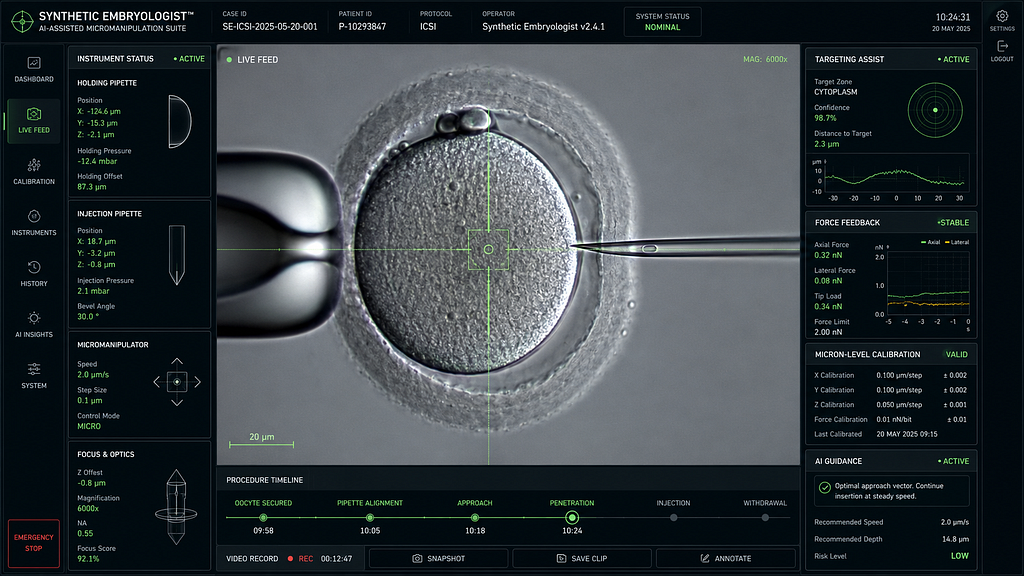
As we dive into a new week at Science for Smile, we shift our focus from the software of embryo selection to the heavy machinery of the lab itself. Today, we examine the dawn of the “Hands-Free IVF Lab” and recent milestone publications in Human Reproduction detailing the first live births achieved through sequential robotic automation. The era of the embryologist as a “micromanipulator” is giving way to the embryologist as a “mission controller.”
Clinical question
Can a fully automated laboratory workflow, integrating robotic oocyte denudation, AI-driven sperm preparation, and robotic ICSI, match human clinical competency and successfully produce healthy live births?
Mechanism
For over 30 years, ICSI has relied on the steady hands and tactile experience of the human embryologist. Robotic ICSI, powered by vision-based micromanipulation, replaces manual pipetting with AI-guided micro-actuators. High-resolution imaging algorithms map the oocyte’s geometry in real-time, identifying the polar body to ensure optimal injection angles. Simultaneously, AI-powered tools like the STAR (Sperm Tracking and Recovery) system scan millions of frames per hour to identify morphologically superior sperm, even in non-obstructive azoospermia (NOA) samples. A robotic holding mechanism then gently stabilises the egg, and the micropipette executes the injection with calibrated, micron-level force, eliminating operator fatigue, resting tremors, and subjective mechanical variation.
Evidence summary
The feasibility of this sci-fi concept is now a clinical reality. A landmark proof-of-concept study published in Human Reproduction (late 2025) reported the first live births resulting from multiple automated systems strung together for Day 0 procedures. Across 11 patients, the automated workflow (handling egg processing, sperm prep, and ICSI) achieved a 64.3% fertilization rate and a 42.2% usable blastocyst formation rate, comfortably meeting established human competency benchmarks. Out of twelve single embryo transfers, five resulted in healthy live births. Additionally, parallel studies utilising AI for single-sperm selection (SiD algorithms) demonstrated up to a 10% higher blastocyst formation rate compared to manual embryologist selection, proving that machines can execute delicate physical procedures without compromising viability.
AI workflow
- Automated Cell Tracking: AI systems (such as CASA and STAR) scan raw semen samples, applying deep learning to isolate rare, viable sperm cells that might be invisible to the human eye during a standard microscopic sweep.
- Vision-Based Micromanipulation: The AI continuously monitors the oocyte via optical coherence, locking onto the polar body to calculate the safest trajectory for the micropipette.
- Robotic Immobilisation and Injection: The automated gripper secures the oocyte, and the robotic arm drives the ICSI needle through the oolemma using a mathematically standardised force, mitigating the risk of structural damage.
- Human Oversight: The senior embryologist sits at a digital dashboard. Rather than physically performing the injection, they review the AI’s locked targets and press a button to authorise the robotic execution.
Limitations/bias
A critical hurdle discussed in the literature is the “Tactile Feedback Gap.” Experienced embryologists rely heavily on the physical “feel” of the oolemma breaking to adjust their pressure mid-injection. Current robotic systems struggle to replicate this intuitive, haptic feedback, which can be problematic when dealing with highly fragile or unusually rigid oocytes. Furthermore, the capital expenditure required to overhaul a traditional lab into a fully robotic ecosystem poses significant Implementation Friction, especially for independent clinics in the Indian market.
Practice takeaway
Standardise to Scale. While your clinic may not be installing robotic arms tomorrow, the transition toward automation is inevitable. For high-volume Indian IVF centres facing embryologist burnout, the immediate takeaway is to embrace “modular automation.” Start by integrating AI-assisted sperm selection software and automated dish preparation tools. By standardising your Day 0 workflow now, your lab will be culturally and technologically primed to adopt full robotic ICSI when the hardware becomes the commercial standard of care.
Santaan Insight
At Santaan, we understand that scaling an IVF practice in India requires balancing high clinical volume with uncompromising precision. The breakthroughs in robotic ICSI validate a philosophy we hold deeply: technology should handle the repetitive precision, freeing humans to handle the strategy. By actively monitoring these robotic advancements and integrating accessible AI tools into our own labs today, Santaan is ensuring that our embryologists remain at the cutting edge. We aren’t just preparing for the future of automated IVF; we are actively curating the technologies that will make “Science for Smile” safer, more consistent, and more successful for every family we serve.
References
- Chavez-Badiola, A., et al. (2025). Automated Oocyte Retrieval, Denudation, Sperm Preparation, and ICSI in the IVF Laboratory: a Proof-of-Concept Study and Report of the First Live Births. Human Reproduction, 40(12), 2910–2922.
- Cohen, Y., et al. (2025). Artificial intelligence in assisted reproductive technology: separating the dream from reality. Reproductive BioMedicine Online, 51(3), 445–452.
- Mendizabal-Ruiz, G., et al. (2025). The Future Use of AI to improve accessibility of assisted reproductive technology in low- and middle-income countries. Reproduction and Fertility, 6(4), 112–120.
For Clinicians: Stay at the forefront of reproductive science. Join our digital health collaborative to access real-time AI-driven benchmarks and advanced dose-prediction tools.
👉 Contact our Clinical Relations Team
https://www.google.com/search?q=https://www.santaan.in/contact-centres
Technical Metadata