
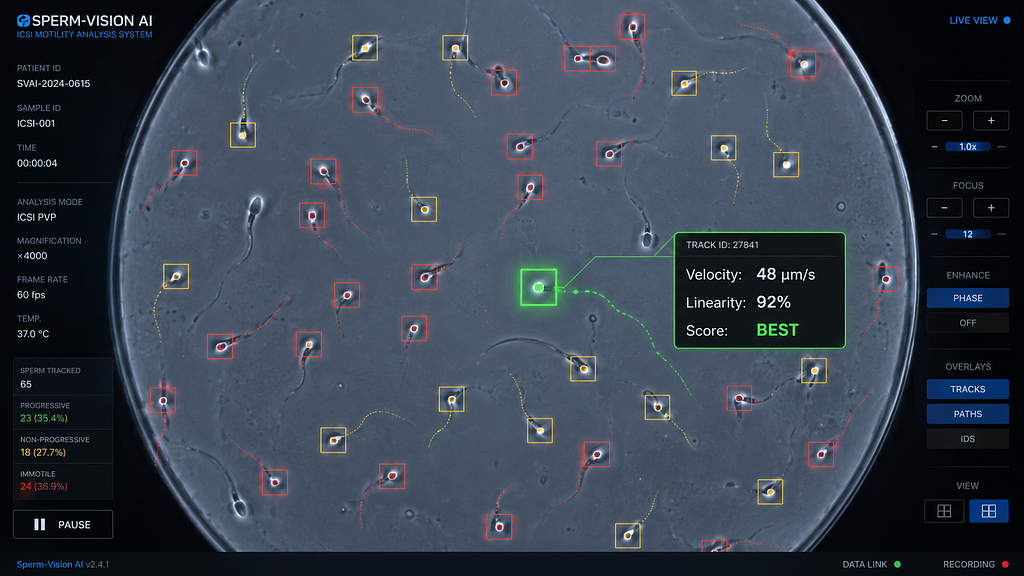
As we close out our deep dive into the AI-driven future of reproductive medicine at our Science for Smile initiative, we turn our attention to the often-overlooked half of the equation: the male factor. While much of the clinical focus in assisted reproductive technology (ART) centers on oocytes, embryos, and the endometrium, the success of Intracytoplasmic Sperm Injection (ICSI) hinges entirely on the selection of a single, optimal spermatozoon.
Today, we explore how real-time computer vision and artificial intelligence (AI) are revolutionizing the ICSI dish. This technology empowers embryologists to execute AI sperm selection based on quantitative, microscopic kinematics rather than subjective visual estimates.
The Clinical Question
Can real-time artificial intelligence algorithms, utilizing computer vision to track sperm kinematics during ICSI, select individual spermatozoa with higher fertilization and blastocyst-development potential compared to standard visual assessment by an embryologist?
The Mechanism: Overcoming Subjectivity with Sperm-Vision AI
Standard ICSI relies heavily on the subjective visual assessment of the embryologist. Looking through a microscope, the human eye attempts to gauge the morphology and motility of rapidly moving sperm in a highly viscous PVP (polyvinylpyrrolidone) solution. This manual process is inherently limited by human visual processing speeds and remains susceptible to fatigue and inter-operator variability.
Enter ‘Sperm-Vision AI’ platforms. These advanced systems integrate directly into the optics of the ICSI microscope. Using sophisticated Convolutional Neural Networks (CNNs) trained on millions of sperm trajectories, the AI simultaneously tracks every spermatozoon in the visual field in real time. It calculates precise kinematic parameters — such as curvilinear velocity, straight-line velocity, linearity, and lateral head displacement — that are physically impossible for a human to measure by eye.
The AI instantly assigns a dynamic, color-coded quality score (e.g., Best, Good, Medium, Low) to each individual sperm, guiding the embryologist’s injection micropipette to the statistically most competent cell to optimize ICSI success rates.
Evidence Summary: Data-Driven Sperm Selection
A pivotal blind, observational study recently published in Reproductive Biology and Endocrinology evaluated an AI-based software for real-time sperm selection during ICSI. The system flawlessly analyzed progressive motility patterns and categorized sperm quality in real time.
The clinical outcomes demonstrated that in cycles utilizing autologous oocytes, the selection of top-tier, AI-categorized ‘Best’ sperm was associated with a statistically significant increase in the blastocyst formation rate.
Furthermore, peer-reviewed data from Reproductive BioMedicine Online confirmed that sperm selected via AI kinematic analysis exhibited marked, quantifiable differences in velocity and linearity compared to human-selected sperm. These objective, data-driven selections directly correlated with improved fertilization rates and a higher percentage of high-quality Day 5 blastocysts, effectively transforming a subjective art into a highly predictive, quantitative science.
The AI Workflow in the ICSI Laboratory
- Sample Preparation: The washed semen sample is placed in the ICSI dish containing PVP drops, standardizing the viscosity for observation.
- Real-Time Tracking: The embryologist activates the AI overlay on the microscope monitor. The software instantly identifies and tracks all sperm within the field of view, functioning at a frame rate far exceeding human capability.
- Kinematic Scoring: The AI calculates the micro-movements of each sperm, overlaying a color-coded bounding box (green for highest competence, red for lowest competence) directly onto the live video feed.
- Precision Capture: The embryologist maneuvers the micropipette to immobilize and aspirate the single ‘green’ spermatozoon for immediate injection into the oocyte.
Limitations and Clinical Considerations
The primary limitation of real-time AI sperm selection is optical clarity. The computer vision algorithm requires a pristine visual field; excessive cellular debris, severe agglutination, or improper microscope calibration can disrupt the AI’s ability to accurately track rapid movements.
Additionally, while AI excels at evaluating external kinematics and gross morphology, it cannot currently assess the internal DNA fragmentation of the live sperm being selected. This means severe underlying genomic defects may still go undetected until embryonic arrest occurs.
For Indian fertility clinics, male factor infertility is a rapidly growing clinical challenge, yet sperm selection protocols have remained largely unchanged for decades. Relying on the human eye to pick the “best-looking swimmer” is an outdated paradigm.
By integrating real-time computer vision into the ICSI workflow, laboratories can drastically reduce operator variability, accelerate the selection process (thereby minimising oocyte exposure time outside the incubator), and ensure that the sperm chosen for injection holds the absolute highest mathematical probability of creating a viable embryo.
Santaan Insight: Elevating Care with Science for Smile
At Santaan, we recognise that the journey to parenthood is a shared endeavour. Our Science for Smile approach demands clinical excellence for both partners. Male factor infertility can be emotionally devastating, and standard semen analyses often leave patients with more questions than answers.
By implementing AI-driven sperm selection in our ICSI laboratories across our network, we are equipping our embryologists with superhuman vision. We are no longer guessing which sperm is the strongest; we are mathematically measuring it. This objective precision ensures that we honour the male partner’s contribution with the highest level of technological scrutiny, ultimately building stronger embryos and brighter smiles.
To learn more about how Santaan is utilising AI to overcome male factor infertility, visit: https://www.santaan.in/clinical-insights
References
- Automated AI for real-time sperm selection in ICSI: reducing variability and studying the role of sperm in embryo development. Reproductive Biology and Endocrinology. pubmed.ncbi.nlm.nih.gov
- Kinematic analysis of spermatozoa and its correlation with ICSI outcomes using artificial intelligence. Reproductive BioMedicine Online. sciencedirect.com
- The evolution of the ICSI dish: Computer vision and machine learning in the andrology lab. Human Reproduction Update. academic.oup.com
Technical Checklist for Publish:
- Editor: @santaanIVF
- Audience: #audience-doctor
- Tags: #audience-doctor #doctor-insights #predictive-modeling #PatientSafety #Fertility