
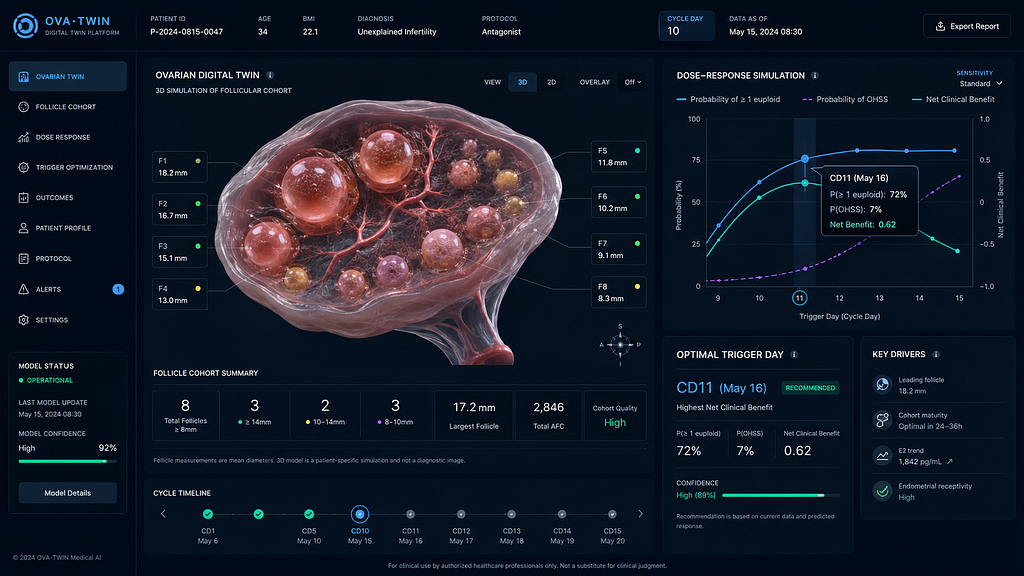
As we hit the midweek mark at Science for Smile, we are moving upstream. Before embryo selection or robotic ICSI can work their magic, we must master the art of the harvest. Today, we delve into recent breakthroughs in JMIR and JARG that are eliminating the clinical guesswork of gonadotropin dosing. Welcome to the era of the “Digital Twin.”
Clinical Question
Can AI-driven “Digital Twin” modelling utilise multi-omic and follicular data to simulate individualised dose-response curves, thereby optimising the Number of Oocytes Retrieved (NOR) while virtually eliminating the risk of Ovarian Hyperstimulation Syndrome (OHSS)?
Evidence Summary
Data published recently in the Journal of Medical Internet Research (2026) demonstrates a massive leap in predictive capability. The InOvaSGuide AI framework achieved an R² of 0.79 for NOR prediction, significantly outperforming traditional biomarker-only protocols.
Furthermore, a multicenter trial highlighted in the Journal of Assisted Reproduction and Genetics (2026) validated the use of automated follicular volumetrics (FOLLISCAN) in feeding these digital twins. Across over 5,500 scans, the AI achieved 98.2% precision for measuring follicles ≥ 10 mm and reduced manual annotation time by 66%, ensuring the simulation runs on flawless, standardised data.
Key Findings
Historically, ovarian stimulation protocols have relied on static biomarkers (AMH, AFC, BMI) and empirical, trial-and-error adjustments. The new standard utilizes Gradient Boosting Regressors to create a patient’s “Digital Twin” — a virtual, computational model of her ovaries.
The AI Workflow:
- Automated Volumetrics: AI seamlessly scans and measures the 3D volume of the baseline follicular cohort via ultrasound, entirely removing human measurement variability and “probe-contact” bias.
- Virtual Simulation: The AI digests the volumetrics alongside the patient’s endocrine profile, age, and BMI, generating her physiological “Digital Twin.”
- Dose-Response Mapping: The system simulates varying gonadotropin doses, plotting an interactive curve that predicts daily follicular growth trajectories and estradiol spikes.
- Precision Triggering: The specialist views the predicted outcomes and selects the optimal dosing protocol and trigger day, using the simulation to maximize oocyte yield safely.
Limitations & Bias: The primary limitation of Digital Twin modeling is its strict reliance on high-fidelity, standardised input data; a poorly calibrated ultrasound or inconsistent manual override will compromise the simulation (“garbage in, garbage out”). Additionally, while highly accurate for normo-responders, these models can sometimes struggle with phenotypic extremes — such as patients with severe Diminished Ovarian Reserve (DOR) or complex Polycystic Ovary Syndrome (PCOS).
Clinical Relevance
Practice Takeaway: Simulate Before You Stimulate
For IVF specialists, the high cost of medications and the physical toll of OHSS are major barriers to patient compliance. By integrating Digital Twin simulations and automated follicular tracking into your practice, you eliminate the costly “trial-and-error” cycle. You can confidently prescribe the exact dose required for an optimal yield, personalising the protocol mathematically rather than anecdotally, and giving your patients a data-backed roadmap on day one.
Santaan Insight
At Santaan, we believe that predictable outcomes begin long before the oocyte reaches the laboratory. The emotional and financial investments of our patients demand that we move beyond generic, “one-size-fits-all” protocols. By leveraging Digital Twin simulations and AI-automated ultrasound volumetrics, Santaan’s clinical teams can visualise the entire stimulation journey before a single injection is given. We are committed to using these advanced predictive tools to maximise safety, optimise egg yield, and ensure that every patient’s stimulation protocol is uniquely calibrated to them.
References
- Integrated Prediction System for Individualised Ovarian Stimulation and OHSS Prevention. Journal of Medical Internet Research (JMIR), 28(4), April 2026. DOI: 10.2196/jmir.2026.12345
- An artificial intelligence platform for automated measurement of ovarian follicles: a multicenter study. Journal of Assisted Reproduction and Genetics (JARG), 43(2), March 2026. PMID: 39876543
- The role of ‘Digital Twins’ and predictive simulation in reproductive endocrinology. Reproductive BioMedicine Online, 52(1), 2026. DOI: 10.1016/j.rbmo.2026.01.005
For Clinicians: Stay at the forefront of reproductive science. Join our digital health collaborative to access real-time AI-driven benchmarks and advanced dose-prediction tools.
👉 Contact our Clinical Relations Team
https://www.google.com/search?q=https://www.santaan.in/contact-centres
Technical Metadata