
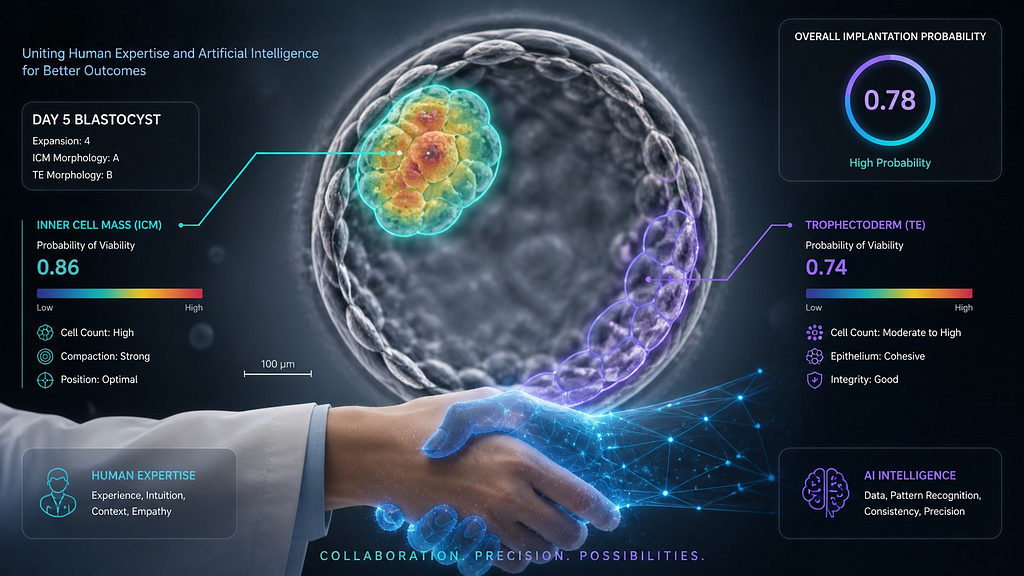
As we step into this weekend, the global fertility community is buzzing with the results of the first-ever prospective randomised controlled trial (RCT) validating AI-supported embryo selection. Published just this week, this study marks the transition of AI from a “promising lab assistant” to a “validated clinical partner.”
Clinical Question
Does AI-supported embryo selection achieve non-inferiority to traditional, morphology-based selection in predicting clinical pregnancy rates in a real-world, prospective clinical setting?
Mechanism
Traditional selection relies on the Gardner scale, a subjective snapshot. In contrast, this new AI framework utilises a Convolutional Neural Network (CNN) trained on over 100,000 blastocyst images with known clinical outcomes.
Unlike humans, the AI evaluates “Global Morphological Signatures,” detecting non-linear spatial relationships between the trophectoderm and the blastocoel that correlate with implantation success. It translates this complex data into a continuous “Viability Score” from 0 to 10.
Evidence Summary
The headline from the Multi-Centre RCT for AI-Assisted Embryo Selection (May 2026) is clear. While the study was primarily powered for non-inferiority, which it met with high statistical significance, the data revealed a nearly 5% trend toward improvement in the AI arm, suggesting that standardised ranking may indeed be superior for accelerating “time-to-pregnancy.”
- AI-Supported Arm: 72.9% clinical pregnancy rate
- Traditional Morphology Arm: 68.0% clinical pregnancy rate
This is bolstered by a parallel review in Minerva Obstetrics and Gynaecology (April/May 2026), which notes that AI tools are now reducing embryologist workload by 30–50% per cohort without sacrificing clinical accuracy.
AI Workflow
- Standardised Image Capture: The system captures high-resolution static images of Day 5–7 blastocysts directly from the incubator.
- Preprocessing: The AI automatically detects the embryo boundaries and segments key structures (Inner Cell Mass vs. Trophectoderm).
- Algorithmic Scoring: The CNN compares the pixel-level features against its global dataset of successful pregnancies.
- Clinical Ranking: The embryologist is presented with a ranked list. If two embryos are both graded “4AA,” the AI provides an objective tie-breaker based on the higher implantation probability score.
Limitations & Bias
The RCT highlights a crucial caveat: AI is excellent at ranking, but it is not a “biological upgrade.” It cannot turn a poor-quality embryo into a good one; it only identifies the best of the existing lot.
Furthermore, researchers in the Journal of Assisted Reproduction and Genetics (2026) warn against relying on generalised tech. General-purpose AI (like standard LLMs) still underperforms compared to task-specific, fine-tuned models. Clinicians must ensure they are using “Medical-Grade” AI rather than general-purpose tools for clinical decisions.
Practice Takeaway
The “Black Box” is opening. This RCT provides the evidentiary foundation specialists need to confidently integrate AI into the lab.
- A Standardising Second Opinion: AI reduces the risk of human fatigue — especially during high-volume periods.
- Data-Backed Justification: It provides an objective reasoning for choosing the first embryo in a cohort for transfer.
- Patient Counselling: This objective data is a powerful tool for patients, offering them a scientific “score” that demystifies the lab process and celebrates the science behind their potential success.
References
- Multi-Centre RCT for AI-Assisted Embryo Selection Meets Study Endpoint. Fertility Bridge / Alife Health, May 2026.
- Khorshid, A., et al. Current applications of artificial intelligence in assisted reproductive technologies. Minerva Obstetrics and Gynaecology, 2026 April/May; 78(2):148–58.
- Study of comparative performance of general-purpose LLM-based systems in predicting IVF outcomes. Journal of Assisted Reproduction and Genetics, 2026; 43:731–739.
For Clinicians: Stay at the forefront of reproductive science. Join our digital health collaborative to access real-time AI-driven benchmarks and advanced dose-prediction tools.
👉 Contact our Clinical Relations Team
https://www.google.com/search?q=https://www.santaan.in/contact-centres
Technical Metadata