
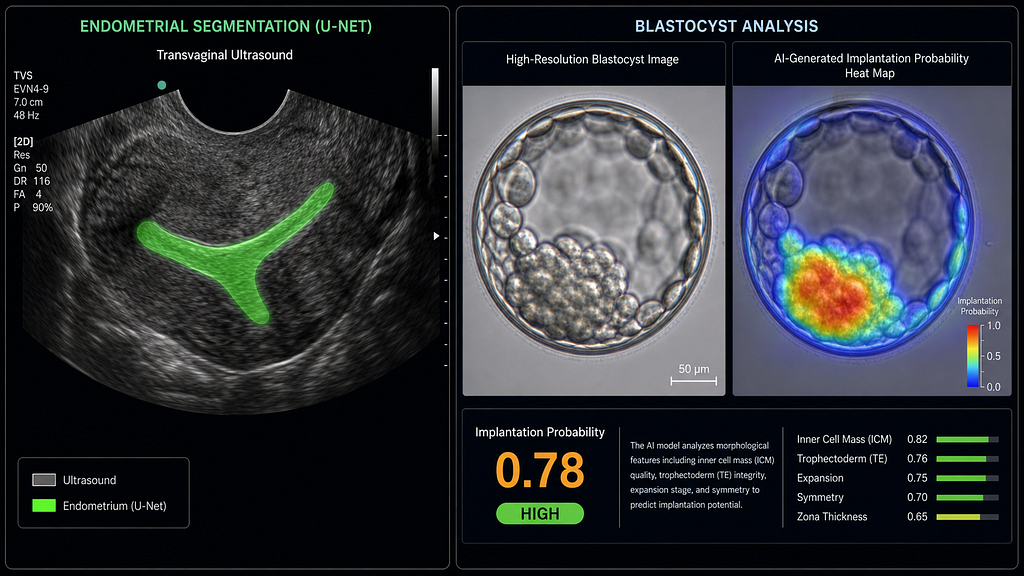
As the global IVF community transitions from purely visual embryo grading to multidimensional predictive modelling, today’s Science for Smile focuses on a breakthrough published this week in Frontiers in Artificial Intelligence.
We are finally seeing the technological merger of the two pillars of reproductive success: the quality of the seed (the embryo) and the readiness of the soil (the endometrium).
Clinical Question
Can a composite AI model that integrates automated ultrasound-based endometrial segmentation with deep-learning embryo grading improve the predictive accuracy of clinical pregnancy rates compared to individual assessments?
The Mechanism
Precision IVF requires perfect synchrony. While traditional ERA (Endometrial Receptivity Analysis) is transcriptomic and invasive, this new approach is image-based and entirely non-invasive.
The framework operates on a dual-stream system:
- The Soil: A U-Net Convolutional Neural Network (CNN) with a VGG16 backbone segments the endometrium from transvaginal ultrasound images. It measures thickness, volume, and trilaminar patterns with a highly accurate Dice similarity coefficient of 0.92.
- The Seed: Simultaneously, a fine-tuned VGG16 classifier evaluates the day-5 blastocyst’s expansion and trophectoderm organisation.
These two data streams are then fused with a clinical probability metric (SART) to generate a unified Composite Score (CS).
Evidence Summary
In a study published on April 26, 2026, researchers demonstrated the staggering potential of this fused approach.
When the Composite Score reached ≥ 6.5, the model’s ability to predict clinical pregnancy achieved an accuracy of 90.7% and a sensitivity of 92.1%. This significantly outperforms standalone embryo grading (which typically hovers around 65–70% accuracy) as well as traditional ultrasound assessments. The data confirms what clinicians have long suspected: in an AI-driven framework, the endometrial “soil” contributes nearly as much predictive weight as the embryonic “seed.”
The AI Workflow in Practice
- Endometrial Capture: A standard 2D/3D transvaginal ultrasound is performed. The AI-driven U-Net automatically segments the basal layer to calculate volume and texture.
- Embryo Classification: Static or time-lapse images (TLI) of the day-5 blastocyst are analysed by the VGG16 classifier for symmetry and expansion stage.
- Data Fusion: The system integrates the patient’s SART clinical data, including age, BMI, and previous reproductive history.
- Composite Output: The specialist is presented with a final probability score (0.0 to 10.0), indicating the optimal window and the best embryo for transfer.
Limitations & Bias
While the U-Net segmentation is highly accurate, it remains sensitive to the quality of the initial ultrasound image. Low-resolution scans or variations in operator technique can lead to “segmentation drift.” Furthermore, the study notes that for patients with specific uterine pathologies — such as adenomyosis or a persistently thin endometrium (< 6 mm) — the model’s predictive value is slightly attenuated. These sub-cohorts will require further specialised training sets to optimise accuracy.
Practice Takeaway
It is time to start thinking in Composite Scores.
We are entering an era where the “Transfer/No-Transfer” decision is no longer a gut feeling based on a “pretty embryo.” In your clinic, begin standardising the capture of mid-cycle ultrasound images alongside your embryo time-lapse data. By moving toward a multidimensional scoring framework, you can offer patients a personalised Implantation Probability Index that accounts for both uterine receptivity and embryonic potential — dramatically reducing the heartbreaking risk of a failed transfer with a perfect embryo.
References
- Artificial intelligence models and combined scoring approaches for endometrial receptivity assessment in in vitro fertilisation. Frontiers in Artificial Intelligence, April 26, 2026.
- Long-term reproducibility and clinical utility of endometrial receptivity analysis in guiding personalised embryo transfer. Frontiers in Reproductive Health, April 2026.
- Artificial Intelligence in Routine IVF Practice: A Roadmap for Responsible Adoption. PMC/MDPI, 2025–2026.
For Clinicians: Stay at the forefront of reproductive science. Join our digital health collaborative to access real-time AI-driven benchmarks and advanced dose-prediction tools.
👉 Contact our Clinical Relations Team
https://www.google.com/search?q=https://www.santaan.in/contact-centres
Technical Metadata