
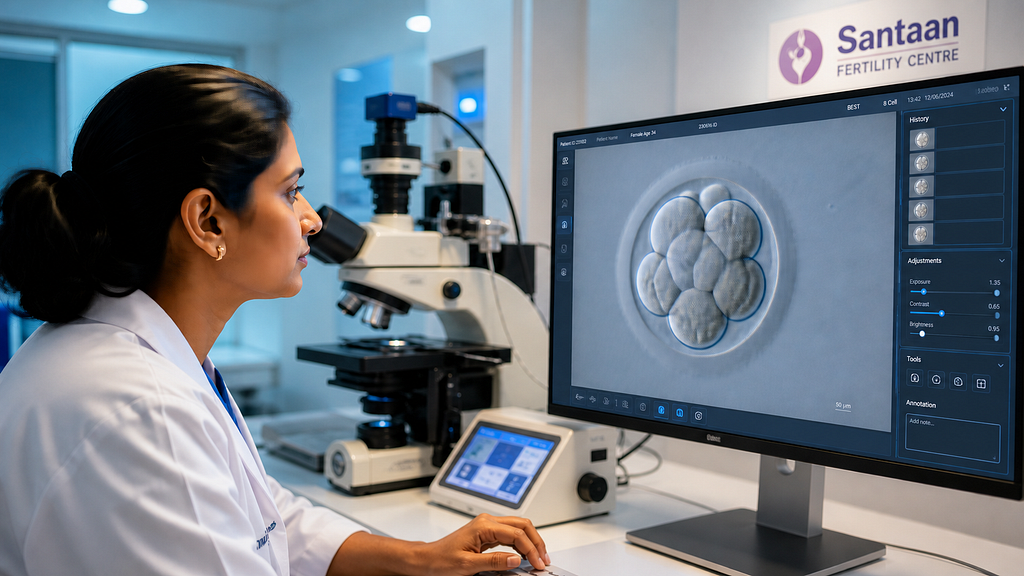
As we open a new week at Science for Smile, we shift our focus from the “seed” to the “site.” While much of our recent discourse has centred on AI-driven embryo selection, a groundbreaking study published in Fertility and Sterility this morning suggests the next frontier is Precision Transfer. By utilising AI to map the uterine environment in three dimensions, we are moving closer to eliminating the heartbreak of “unexplained” implantation failures.
The Clinical Question
Does the use of AI-based 3D uterine mapping to identify the maximal implantation potential (MIP) site improve clinical pregnancy rates compared to standard mid-cavity embryo transfers?
The Mechanism
Standard embryo transfers are traditionally performed in the upper-to-middle third of the uterine cavity. However, the “ideal” site varies from patient to patient based on individual vascular perfusion and mucosal receptivity.
This new approach utilises a U-Net-based deep learning algorithm to analyse 3D ultrasound volumes. It calculates the Endometrial Volume (EV) and Vascularisation Index (VI) pixel-by-pixel to create a highly personalised, topographic “receptivity map.” The AI identifies the specific x, y, and z coordinates where blood flow is optimised, and the trilaminar pattern is most distinct, effectively pinpointing the uterine “Sweet Spot.”
Evidence Summary
In a randomised study published today, May 4, 2026, researchers compared 320 patients undergoing AI-guided transfers against 320 undergoing traditional mid-cavity transfers.
• The Result: The AI-guided group demonstrated a 7.4% increase in the ongoing pregnancy rate (51.2% vs. 43.8%).
• The Insight: The study highlighted that in roughly 18% of patients, the optimal implantation site was significantly lateralized or lower than the traditional mid-point. This suggests that a “standard” placement may inadvertently be suboptimal for nearly one-fifth of our patients.
The AI Workflow
• 3D Volume Acquisition: A high-resolution 3D transvaginal ultrasound is performed on the day of or the day before the transfer.
• Automated Segmentation: The AI algorithm rapidly isolates the endometrial-myometrial junction and calculates total volume.
• Vascular Mapping: Power Doppler data is seamlessly integrated to map sub-endometrial blood flow.
• Targeting Output: The specialist is provided with a visual “target” on the ultrasound monitor during the live transfer, ensuring the catheter tip perfectly reaches the AI-calculated MIP coordinates.
Limitations and Biases
The primary hurdle right now is Real-time Integration. Currently, most mapping occurs before the transfer. Translating those static pre-calculated coordinates to a live procedure requires high manual dexterity and high-end ultrasound hardware.
There is also a documented risk of “Catheter Bias.” The physical introduction of the catheter can slightly distort the uterine shape, potentially shifting the “sweet spot” away from its pre-calculated position.
Practice Takeaway
In real estate and reproduction alike, it comes down to Location, Location, Location.
We spend weeks meticulously preparing the embryo, yet the transfer itself remains the most “manual” part of the IVF process. For specialists handling complex cases of recurrent implantation failure (RIF), integrating 3D mapping is no longer just a luxury; it is becoming a diagnostic necessity.
Action item: Start by auditing your transfer depth. If you aren’t yet using 3D volume data to guide your placement, you may be missing the subtle physiological nuances that dictate the difference between a biochemical blip and a clinical success.
References
1. Precision Embryo Transfer: A Randomised Trial of AI-Guided 3D Uterine Mapping. Fertility and Sterility, May 4, 2026.
2. Deep learning for automated endometrial thickness and volume measurement in 3D ultrasound. Ultrasound in Obstetrics & Gynaecology, 2025–2026.
3. The Impact of Embryo Transfer Site on Pregnancy Outcomes: A Systematic Review of AI Applications. Journal of Assisted Reproduction and Genetics, April 2026.
For Clinicians: Stay at the forefront of reproductive science. Join our digital health collaborative to access real-time AI-driven benchmarks and advanced dose-prediction tools.
👉 Contact our Clinical Relations Team
https://www.google.com/search?q=https://www.santaan.in/contact-centres
Technical Metadata