
Welcome to Science for Smiles Daily. Let’s dive into today’s most compelling FertiTech insights tailored for the modern Indian IVF practice.
The Clinical Question
Can we achieve a higher echelon of precision in predicting IVF implantation potential by synergising AI-driven embryo quality scores with automated endometrial receptivity metrics, and what ethical guardrails must we implement to avoid losing our clinical sovereignty?
Mechanism
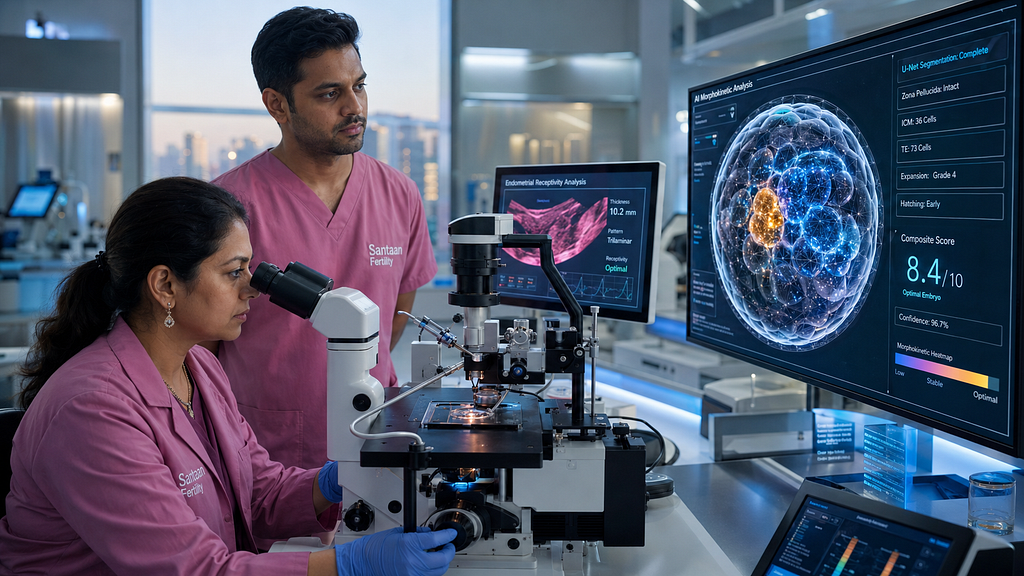
We are witnessing a rapid paradigm shift from isolated, embryo-centric evaluation to holistic, dual-factor AI modelling. Novel frameworks are now deploying U-Net convolutional neural networks for pixel-wise endometrial segmentation, precisely mapping thickness, pattern, and volume, coupled seamlessly with fine-tuned VGG16 classifiers for morphokinetic embryo quality assessment (Bornaun, n.d.). By mathematically fusing these deep-learning inputs with standard clinical probability data, these algorithms generate a unified “Composite Score” (CS).
Concurrently, advanced post-conception machine learning models utilising extreme gradient boosting (XGBoost) are untangling complex, non-linear physiological relationships to predict the risk of miscarriage versus live birth immediately following pregnancy confirmation (Agirsoy, n.d.).
Evidence Summary
The precision of these emerging tools is staggering. Automated endometrial thickness measurements via AI are now achieving an incredibly tight mean absolute error (MAE) of just 0.21 mm compared to manual expert sonography (Bornaun, n.d.). On the embryology front, AI models evaluating six developmental keyframes have demonstrated up to a 97.9% concordance rate with the transfer decisions of senior embryologists (Minano Masip, n.d.).
Yet, as we embrace this predictive power, the literature raises a crucial red flag: the ethical risk of “machine paternalism.” Over-relying on opaque deep learning algorithms could inadvertently commodify the reproductive process and sideline shared decision-making with our patients (Aufieri & Mastrocola, 2025).
AI Workflow in the Clinic
- Automated Ingestion: Transvaginal ultrasound (TVUS) images are fed into a U-Net model to map the endometrial lining, while continuous time-lapse embryo images are analysed by a VGG16 network.
- Algorithmic Feature Extraction: The AI rigorously and objectively quantifies parameters like blastomere symmetry, trophectoderm organisation, and endometrial echogenicity without observer fatigue.
- Composite Output Generation: The system synthesises these variables into an actionable Composite Score. A CS > 7 acts as a highly confident, data-backed green light for optimal implantation timing (Bornaun, n.d.).
Limitations & Bias
We must wear our sceptical spectacles. Deep learning models inherently reflect the data they ingest; algorithms trained predominantly on Western demographics risk poor generalizability and implicit bias when applied to our diverse Indian patient populations. Furthermore, the notorious “black-box” nature of some neural networks obscures why an embryo received a specific score, limiting our ability to transparently counsel expectant parents. Without sweeping multi-centre randomised controlled trials, the unchecked clinical deployment of completely autonomous AI-driven embryo selection remains ethically precarious (Aufieri & Mastrocola, 2025).
Practice Takeaway
Do not surrender your clinical intuition to the machine. Treat these sophisticated composite AI scores as an adjunct to your expertise, not a replacement. Leverage FertiTech to standardise your clinic’s routine sonographic measurements and streamline high-volume embryology workflows, but maintain a firm “human-in-the-loop” philosophy. Your judgment, empathy, and localised clinical experience remain the ultimate drivers of patient success.
References
Agirsoy, M. (n.d.). Development of an explainable machine learning model to predict live birth versus miscarriage among in vitro fertilisation-embryo transfer pregnancies. Journal of Medical Artificial Intelligence.
Aufieri, R., & Mastrocola, F. (2025). Balancing Technology, Ethics, and Society: A Review of Artificial Intelligence in Embryo Selection. Information, 16(1), 18. https://doi.org/10.3390/info16010018 Cited by: 10
Bornaun, T. (n.d.). Artificial intelligence models and combined scoring approaches for endometrial receptivity assessment in in vitro fertilisation. Frontiers.
Minano Masip, J. (n.d.). Pregnancy AI: Development and Internal Validation of an Artificial Intelligence Tool to Predict Live Births in ICSI and IVF Cycles Using Clinical Features and Embryo Images. MDPI.
For Clinicians: Stay at the forefront of reproductive science. Join our digital health collaborative to access real-time AI-driven benchmarks and advanced dose-prediction tools.
👉 Contact our Clinical Relations Team
https://www.google.com/search?q=https://www.santaan.in/contact-centres
Technical Metadata