Clinical Question
Does the integration of dual-AI platforms specifically designed for sperm identification (SiD) and embryo ranking (ERICA) improve fertilisation and first-cycle success rates in the Indian IVF population?
Mechanism
While traditional AI models are often trained almost exclusively on Caucasian datasets, the SiD (Sperm Identification Device) and ERICA (Embryo Ranking Intelligent Classification Assistant) platforms stand out by integrating Indian-specific genomic and clinical data.
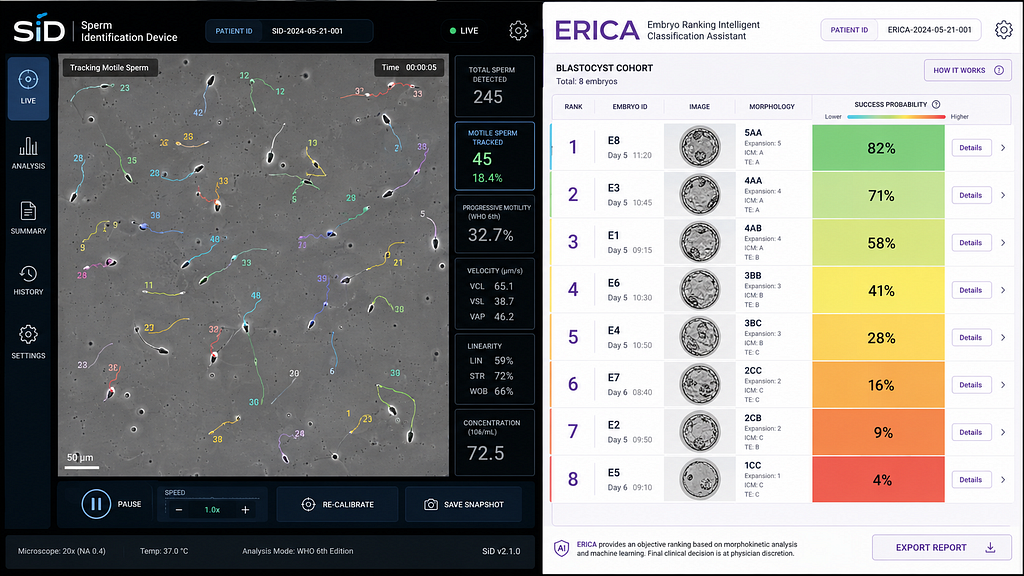
• SiD: Utilises high-speed computer vision to analyse sperm across approximately 2.5 million parameters, identifying the most kinetically and morphologically viable sperm for Intracytoplasmic Sperm Injection (ICSI).
• ERICA: Employs deep learning to provide an objective, non-invasive ranking of blastocysts from static images. It correlates morphological features with known implantation outcomes derived directly from domestic cohorts.
Evidence Summary
Early clinical observations reported in early 2026, including data presented by major Indian fertility networks and highlighted by publications like The Hindu, suggest that these AI tools can increase the first-cycle IVF success rate by 5–7%.
The use of SiD has led to a measurable improvement in blastocyst development rates by standardising the selection of sperm with the highest functional competence. This innovation is particularly vital for the Indian context, where approximately 13% of couples face infertility and male factor issues are increasingly being addressed with equal clinical rigour.
AI Workflow
1. Sperm Profiling (SiD): During the ICSI prep, the AI tracks all moving sperm in the PVP drop, rapidly scoring them against its 2.5-million-parameter database.
2. Guided Injection: The embryologist selects the “AI-optimised” sperm for microinjection, significantly reducing the inherent subjectivity of manual selection.
3. Embryo Ranking (ERICA): Once embryos successfully reach the blastocyst stage, their static images are captured and analysed.
4. Integrated Probability: The system generates a ranked list, empowering the specialist to confidently choose the embryo with the highest data-backed potential for the initial transfer.
Limitations and Bias
Despite the crucial inclusion of Indian genomic data, the “Black Box” nature of machine learning, especially analyses involving 2.5 million parameters , remains a hurdle for total clinical transparency.
Additionally, while these tools are non-invasive and actively improve “first-cycle” success, they do not eliminate baseline biological constraints. Conditions such as advanced maternal age or severe endometriosis still dictate the ceiling of success and require comprehensive, traditional clinical management.
Practice Takeaway
Precision is now a local reality.
For Indian specialists, the introduction of AI tools like SiD and ERICA represents a definitive move toward “Precision IVF” that respects and utilises local biological variations. By implementing these “second-reader” systems, clinics can reduce the trial-and-error burden on patients, ultimately lowering the cumulative financial and emotional costs of treatment.
During your next clinical review, consider how these specific, Indian-validated tools could be leveraged to counsel your patients more accurately regarding their “first-cycle” probabilities.
References
1. AI tools to increase IVF success rate and reduce patient costs: Introduction of SiD and ERICA in New Delhi. The Hindu / Gaudium IVF, April-May 2026.
2. How AI is Transforming IVF Success Rates in 2026: What Patients Need to Know. ARTBaby / Clinical Reports, April 24, 2026.
3. Multi-Centre RCT for AI-Assisted Embryo Selection Meets Study Endpoint. Fertility Bridge / Alife Health, March-May 2026.
For Clinicians: Stay at the forefront of reproductive science. Join our digital health collaborative to access real-time AI-driven benchmarks and advanced dose-prediction tools.
👉 Contact our Clinical Relations Team
https://www.google.com/search?q=https://www.santaan.in/contact-centres
Technical Metadata