As we conclude this week’s briefings at Science for Smile, we turn our attention to the very beginning of the IVF pipeline. While much of the AI revolution has traditionally focused on the embryo, the latest data from May 2026 shifts the spotlight entirely to the oocyte. We are entering the era of “Oocyte Intelligence”, a time when deep learning is finally providing the objective metrics needed to predict developmental potential before fertilisation ever occurs.
Clinical Question
Does automated, AI-driven morphological assessment of oocytes improve the prediction of fertilisation success and blastocyst conversion compared to traditional embryologist evaluation?
Mechanism
Historically, oocyte grading has been the “neglected sibling” of embryo grading, often limited to simple binary classifications (MII vs. MI/GV). However, cytoplasmic dysmorphisms, such as granularity, vacuolization, and perivitelline space abnormalities, carry significant prognostic weight.
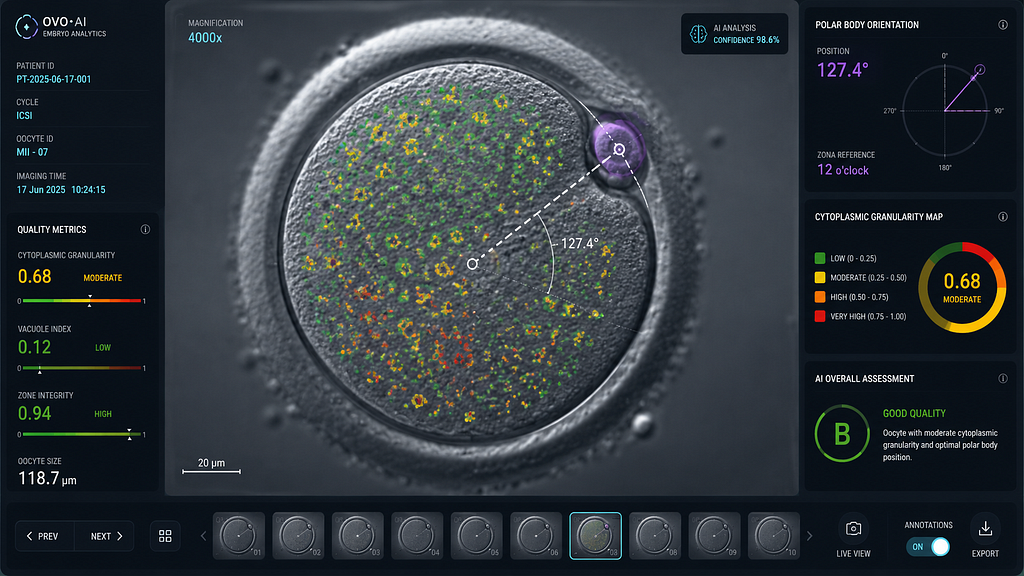
New AI frameworks published this month utilise Deep Convolutional Neural Networks (DCNNs) to perform pixel-level analysis of high-resolution oocyte images. By quantifying subtle features like the Cytoplasmic Granularity Index (CGI) and the precise circularity of the polar body, the AI evaluates the egg to generate an actionable Oocyte Competence Score (OCS).
Evidence Summary
In a comprehensive review published in the International Journal of Reproduction, Contraception, Obstetrics and Gynaecology (IJRCog, 2026), researchers highlighted that AI models can reduce human error and improve grading consistency by detecting developmental patterns invisible to the human eye.
This is bolstered by recent 2026 data from multicenter trials, which show that AI systems can achieve 10% to 25% higher accuracy in predicting implantation potential when oocyte metrics are integrated into early-stage models. For the Indian clinician, this represents a vital tool in managing the growing number of patients with PCOS or age-related fertility decline, where oocyte quality is often the primary limiting factor.
The AI Workflow
1. Image Acquisition: High-resolution static images are captured immediately after denudation but before ICSI.
2. Feature Segmentation: The AI precisely isolates the zona pellucida, oolemma, and polar body.
3. Phenotypic Analysis: The model calculates the texture of the cytoplasm and measures the volume of the perivitelline space.
4. Competence Ranking: The embryologist receives a predictive score for each oocyte. This can be used to prioritise the order of ICSI or to counsel patients on the likelihood of obtaining viable blastocysts from the cohort.
Limitations and Bias
The primary challenge in this space remains Data Variability. Algorithms trained on specific culture media or imaging hardware may experience “performance drift” when utilised in different laboratory environments.
Furthermore, while AI excels at morphological assessment, it cannot yet definitively predict the ploidy status of the oocyte without an invasive polar body biopsy. As noted by experts at the 2026 ETHealthworld Fertility Conclave, we must maintain a “human-in-the-loop” approach to ensure these algorithms assist, rather than replace, the critical clinical judgment of the embryologist.
Practice Takeaway
Start at the Start. We often wait until Day 5 to give patients definitive news, but Oocyte Intelligence allows for earlier, data-backed conversations. In your practice, consider utilising AI oocyte scoring, particularly for Egg Freezing (Social/Medical Cryopreservation) cycles. It provides a more realistic expectation of future success for the patient, moving the conversation beyond the simple “number of eggs frozen” to the true “quality of the cohort preserved.”
References
1. Reddy, K. R., & Deotale, G. (2026). Artificial intelligence in embryo selection: enhancing precision and overcoming traditional limitations in in vitro fertilisation. IJRCOG, 15(2), February 2026.
2. Artificial Intelligence in in-vitro fertilisation (IVF): A New Era of Precision and Personalisation. ResearchGate / Narrative Review, April 24, 2026.
3. AI will bring consistency and data-led precision in fertility care: Experts. ETHealthworld Fertility Conclave, March-May 2026.
For Clinicians: Stay at the forefront of reproductive science. Join our digital health collaborative to access real-time AI-driven benchmarks and advanced dose-prediction tools.
👉 Contact our Clinical Relations Team
https://www.google.com/search?q=https://www.santaan.in/contact-centres
Technical Metadata