
Clinical question
Can AI-enhanced non-invasive preimplantation genetic testing (niPGT) of spent culture media provide comparable aneuploidy detection to traditional invasive trophectoderm (TE) biopsy, without compromising embryo integrity?
Mechanism
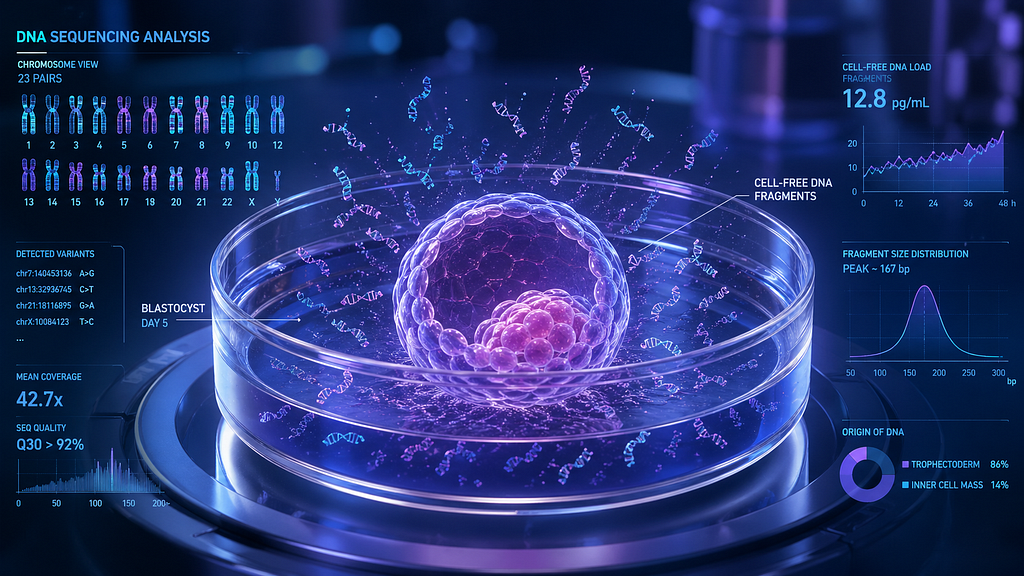
During in vitro development, human preimplantation embryos naturally release cell-free DNA (cfDNA) into the blastocoel fluid and surrounding culture medium. niPGT collects this spent culture medium instead of physically excising cells from the embryo. Next-generation sequencing (NGS) amplifies the minute amounts of cfDNA. Artificial intelligence, specifically advanced machine learning and bioinformatic algorithms, is then applied to interpret the complex sequencing data, separating true embryonic chromosomal signatures from background noise and maternal cumulus cell contamination.
Evidence summary
Recent 2026 literature highlights a critical transition phase for niPGT technologies. Advances in machine learning have vastly improved the diagnostic accuracy of analysing cell-free embryonic DNA. According to contemporary reviews in assisted reproduction and reproductive genetics, AI integration helps overcome the traditionally low signal-to-noise ratio in spent culture media. Clinical trials comparing invasive PGT-A with AI-backed niPGT are reporting highly concordant ploidy results. Most importantly, studies confirm that avoiding the mechanical stress of a biopsy preserves embryo integrity, resulting in clinical pregnancy and implantation rates that are comparable to, or in some fragile cohorts better than, traditional invasive biopsy cycles.
AI workflow
1. Culture & Collection: Embryos are cultured undisturbed to the blastocyst stage. On day 5 or 6, the spent culture medium (which contains the embryonic cfDNA) is carefully aspirated and preserved.
2. Next-Generation Sequencing (NGS): The cell-free DNA undergoes whole-genome amplification and is sequenced.
3. Machine Learning Interpretation: AI models process the raw NGS data. The algorithm cross-references genetic markers to differentiate maternal DNA contamination from embryonic DNA, calculating the precise ploidy status.
4. Clinical Reporting: The software generates an objective diagnostic score predicting the likelihood of euploidy, aneuploidy, or mosaicism, allowing the embryologist to rank the cohort for transfer.
Limitations/bias
The primary biological hurdle remains maternal DNA contamination. If cumulus cells are not completely stripped before culture, maternal cfDNA can easily overwhelm the embryonic signal, leading to false-negative aneuploidy results (diagnosing a female euploid embryo when it is actually abnormal). Furthermore, while AI improves data interpretation, standardising the exact volume and timing of media collection across different IVF laboratories is necessary before niPGT can achieve universal diagnostic reliability.
Practice takeaway
Non-invasive PGT is rapidly moving from an experimental concept to a viable clinical tool for embryo prioritisation. While it may not completely replace invasive TE biopsies for strict single-gene disorder diagnostics immediately, it is an excellent prioritisation tool. For patients with fragile embryos, low blastocyst yield, or severe risk aversion to biopsy procedures, adopting AI-assisted niPGT into your laboratory workflow offers a gentler, more embryo-friendly pathway to improving single embryo transfer (SET) outcomes and reducing time-to-pregnancy.
References
1. Global Preimplantation Genetic Testing Market Size 2025–2034. Custom Market Insights, Feb 2026.
2. Advances in non-invasive preimplantation genetic testing (niPGT). inviTRA Medical Review, April 2026.
3. Non-Invasive Approaches for the Assessment of Human Preimplantation Embryos. Frontiers in Reproductive Health, April 2026.
For Clinicians: Stay at the forefront of reproductive science. Join our digital health collaborative to access real-time AI-driven benchmarks and advanced dose-prediction tools.
👉 Contact our Clinical Relations Team
https://www.google.com/search?q=https://www.santaan.in/contact-centres
Technical Metadata