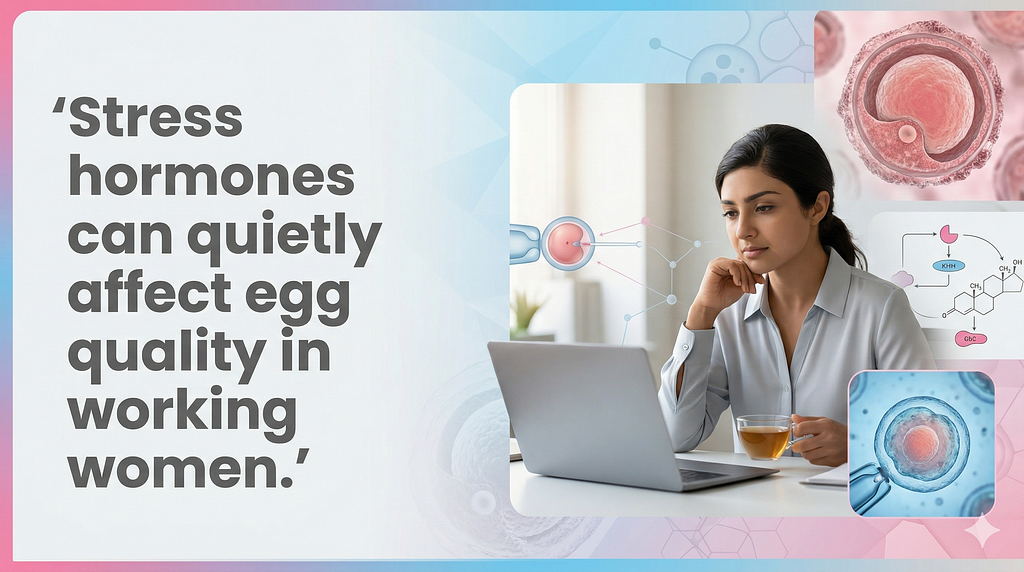
For the working woman in Bhubaneswar, Ranchi, or Patna, the daily rhythm is a familiar one.
The morning alarm rings not just for you, but for the countless responsibilities waiting, a presentation to finalise, a household to manage, perhaps a silent hope tucked away in your heart.
This constant state of ‘being on’ is like living in a city where the emergency sirens never fully stop. A low, persistent wail of cortisol, your body’s primary stress hormone, becomes the background score to your life. And in this environment, the most delicate of processes, like the maturation of a healthy egg, can struggle to be heard.
The Emotional Truth
You tell yourself you’re managing. You’re the capable one, the one who ‘juggles it all.’ But inside, there’s a quiet fracture. The frustration when another cycle passes. The guilt when you feel too tired to ‘try’ at the right time.
The unspoken fear that your ambition, your very ability to provide and care for your family, is somehow working against your deepest wish to start one. You’re not failing; you’re fighting a battle on two fronts, and one is invisible.
What’s Really Happening in Your Body: The Cortisol Cascade
Think of your hormonal system as a sophisticated corporate hierarchy. The hypothalamus in your brain is the CEO, setting the overall reproductive strategy. It sends orders (GnRH) to the pituitary gland, the middle manager, which then instructs the ovaries, the dedicated team on the ground, to recruit and nurture eggs.
Chronic stress inserts a blaring, red-alert intercom into this chain of command. When cortisol is constantly high, it’s like the CEO is perpetually distracted by crisis management. The clear, steady orders for reproduction get downgraded or delayed.
The pituitary gland receives confused signals, which can disrupt the precise release of Follicle Stimulating Hormone (FSH) and Luteinizing Hormone (LH). This disruption can lead to irregular cycles or even anovulation (where no egg is released).
But the impact goes deeper than just ovulation. Inside the developing ovarian follicle, high cortisol creates a hostile microenvironment. It increases oxidative stress, a kind of cellular rust that can damage the delicate DNA of the egg itself.
An egg with compromised DNA is less likely to fertilise properly or develop into a healthy embryo.
This is why two women with the same AMH (egg reserve) level can have vastly different egg quality; one’s internal environment may be calm and supportive, the other’s may be under siege.
And this is a shared journey. While this post focuses on women, stress impacts male fertility too. In men, chronic stress can reduce testosterone, affect sperm production, and increase sperm DNA fragmentation. It’s a team effort, and the team’s environment matters.
Why Tests Feel Confusing
You might have had basic tests done. Your thyroid (TSH) is normal. Your periods are fairly regular. The doctor may have said your reports are ‘fine.’
This is where the gap between ‘normal’ and ‘optimal for conception’ becomes critical.
A standard blood test might check your cortisol at a single point in time, often in the morning. But cortisol has a diurnal rhythm; it should be high in the morning to wake you up and taper off to a low whisper by bedtime.
Chronic stress flattens this curve. Your cortisol might be moderately high all day and fail to drop sufficiently at night.
This pattern disrupts sleep and further harms reproductive hormones. A single snapshot misses the whole story of the stress burden your body is carrying.
What You Can Actually Do
This isn’t about adding more to your plate. It’s about strategic, evidence-based shifts.
• The 15-Minute Buffer Rule: After you log off from work, create a mandatory 15-minute ritual before you step into home responsibilities. This is a ‘command centre reset.’ It could be a quiet cup of tea looking out the window, a short walk without your phone, or simply sitting and breathing deeply.
This acts as a psychological signal to lower the alarm, helping to initiate the cortisol wind-down process.
• Dietary Shield — The Magnesium Factor: Stress depletes magnesium, a mineral crucial for hundreds of enzymatic reactions, including those involved in hormone regulation.
Incorporate one magnesium-rich food daily: a handful of pumpkin seeds (kaddu ke beej) in your lunch, a banana, or a serving of spinach (palak) sabzi. This helps your nervous system stay resilient.
• Investigate Your Rhythm: Consider a Diurnal Cortisol Saliva Test. This test measures your cortisol at four key points during the day (upon waking, noon, evening, bedtime) to map your curve. It moves beyond ‘yes/no’ and shows ‘how and when.’ Knowing your pattern is the first step to correcting it.
• Reframe ‘Self-Care’: It is not selfishness. It is system maintenance. Just as you would not run a costly generator 24/7 without service, you cannot run your body in a constant state of high alert without supporting its recovery. Ten minutes of guided breathing or gentle stretching is not a luxury; it’s a biological necessity for fertility.
Santaan Insight
• Research indicates that women with high perceived stress can take up to 29% longer to conceive compared to those with lower stress, independent of age.
• We see a significant pattern in Eastern India, where working women often present with excellent ovarian reserve (AMH) but poorer-than-expected egg or embryo quality. Addressing the stressful environment is a key lever in bridging this gap.
• Managing stress is not about achieving a state of zero worry; it’s about reducing the chronicity of the stress response, giving your body windows of recovery to prioritise reproduction.
Your Gentle Next Step
You don’t have to diagnose or solve this alone. Understanding your unique stress biology is the first step toward reclaiming a supportive internal environment for conception.
At Santaan, our Fertility Resilience Assessment includes a review of lifestyle factors, hormonal rhythms, and personalised strategies that fit into your real life in Cuttack, Jamshedpur, or Guwahati.
Let’s map your cortisol curve and build a plan that supports both your career and your dream of a family.
At Santaan, we meet you where the science is and where you are.
Learn More About Our Fertility Resilience Program.
WhatsApp us at: +91 97772 68743