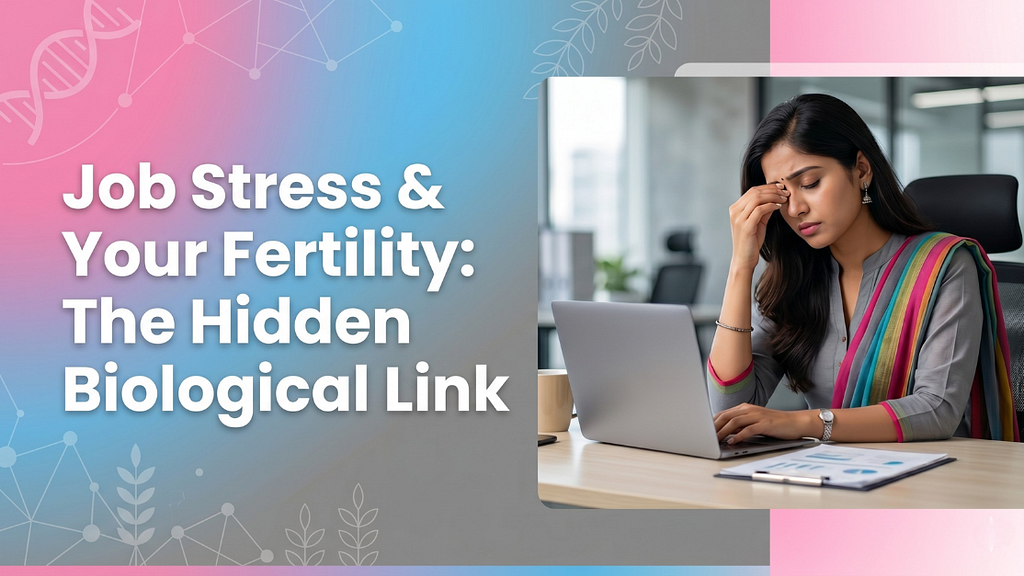
What people believe: My demanding job is just a hurdle to overcome; the late nights and high-pressure deadlines are simply the price of professional success.
What the evidence shows: The chronic stress stemming from a high-octane work environment could be silently and significantly impacting your fertility.
In today’s fast-paced professional world, the line between dedication and overwork is frequently blurred. We are conditioned to view stress as a badge of honour, a byproduct of ambition. However, when you are trying to conceive, your body interprets this modern-day hustle very differently. The biological toll of constant workplace pressure goes far beyond mental exhaustion; it physically alters the delicate hormonal balance required for reproduction.
Understanding the profound connection between the mind and the reproductive system is the first step toward protecting your health. Let us separate the pervasive myths from the scientific facts regarding occupational stress and your fertility journey.
The Biological Reality: How Stress Alters Your Body
To understand why a demanding job impacts your ability to conceive, we have to look closely at human biology. According to extensive research, including studies highlighted by the American Society for Reproductive Medicine (ASRM), chronic stress fundamentally alters the body’s internal communication networks.
The primary culprit is the disruption of the hypothalamic-pituitary-adrenal (HPA) axis. When you are constantly stressed by impending deadlines or demanding managers, your brain perceives a state of continuous threat. In response, the HPA axis goes into overdrive, flooding your system with stress hormones like cortisol and adrenaline.
From an evolutionary standpoint, this “fight or flight” response is designed to keep you alive in dangerous situations. Your body intelligently decides that a period of extreme danger is not the right time to bring a new life into the world. Consequently, the elevated cortisol levels begin to suppress the production of gonadotropin-releasing hormone (GnRH). This suppression cascades down, inhibiting the release of luteinizing hormone (LH) and follicle-stimulating hormone (FSH).
For women, this hormonal imbalance can lead to irregular menstrual cycles, delayed ovulation, or even anovulation (the complete absence of ovulation). For men, chronic stress can negatively impact testosterone levels, reduce sperm count, and affect sperm motility and morphology. The physiological reality is clear: chronic job stress creates an internal environment that actively deprioritises reproduction.
Separating Fact from Fiction
When discussing reproductive health, misinformation is abundant. Breaking down these misconceptions is vital for taking control of your well-being.
Myth: Stress is the sole cause of infertility.
Fact: While chronic stress heavily influences reproductive health, it is rarely the only cause of infertility. It is an aggravating factor that complicates the process. Fertility is multifactorial, involving genetics, age, and underlying medical conditions. Stress acts as an amplifier to existing issues and a barrier to natural conception, but diagnosing it as the singular cause oversimplifies a complex medical reality.
Myth: If you just “relax and take a vacation,” you will get pregnant.
Fact: This is perhaps the most frustrating myth couples hear. Telling someone experiencing the deep anxiety of fertility struggles to “just relax” is not only dismissive but scientifically flawed. Undoing the effects of chronic HPA-axis activation requires consistent, daily physiological management, not just a temporary break from the office.
Myth: Only the woman’s stress levels matter.
Fact: Fertility is a shared equation. Male occupational stress is a highly significant factor. Prolonged exposure to high-pressure work environments degrades semen parameters and lowers libido, making stress management an essential practice for both partners.
The Field of Control: Managing Job Stress for Fertility
Effectively mitigating work-related stress requires a shift in how you engage with your professional environment. It helps to divide your work life into two categories: your “field of action” (what you can directly control) and the external forces (what you cannot control).
You cannot control a volatile market, a sudden shift in company policy, or a demanding client. However, you are in complete control of your reactions, your personal boundaries, and your daily recovery routines. By focusing solely on your field of action, you prevent external chaos from triggering your internal stress response.
Evidence-Based Stress Reduction Techniques
To actively lower cortisol and support your reproductive system, consider integrating the following proven techniques into your daily routine:
• Yoga and Mindful Movement: Yoga is not just physical exercise; it is a profound tool for nervous system regulation. A study published in the Journal of Clinical Endocrinology and Metabolism found that women who consistently practised yoga experienced improved ovulation rates and enhanced overall fertility compared to those who did not. The combination of specific postures and focused awareness helps transition the body from a sympathetic (fight-or-flight) state to a parasympathetic (rest-and-digest) state.
• Deep Breathing Exercises: Techniques such as diaphragmatic breathing or the 4–7–8 method act as a manual override for your nervous system. Just five minutes of intentional deep breathing during a chaotic workday can halt the overproduction of adrenaline and stabilise your heart rate.
• Meditation and Mindfulness: Regular meditation physically shrinks the amygdala (the brain’s fear centre) over time. Practising mindfulness helps you observe workplace stressors objectively without internalising them, protecting your hormonal baseline.
• Digital Boundaries: The “always-on” culture is a modern fertility hazard. Establish strict cut-off times for work emails and messages to ensure your brain has the necessary downtime to recover each evening.
Frequently Asked Questions
Q: Can stress completely cause infertility?
A: Chronic stress can severely affect fertility in both men and women by disrupting crucial reproductive hormones. However, it is generally considered a contributing factor rather than a direct, singular cause of absolute infertility. It makes conceiving much more difficult, but it usually operates alongside other variables.
Q: How can I manage my demanding job to improve my chances of conceiving?
A: The key is consistent, daily regulation of your nervous system. Techniques such as restorative yoga, daily meditation, and dedicated deep breathing exercises have been clinically shown to reduce stress hormones and improve fertility outcomes. Additionally, setting firm professional boundaries to prevent burnout is non-negotiable.
Q: Are there advanced fertility treatments available locally if stress management isn’t enough?
A: Yes, there are numerous advanced clinics and treatments available to support your journey. Depending on your specific medical profile, specialists can offer interventions ranging from fertility medications and ovulation induction to Intrauterine Insemination (IUI) and In Vitro Fertilisation (IVF). Consulting a specialist can provide a tailored roadmap.
What steps can you take today to reduce stress and improve your fertility?
To know more, book a consultation with us: +91 97772 68743