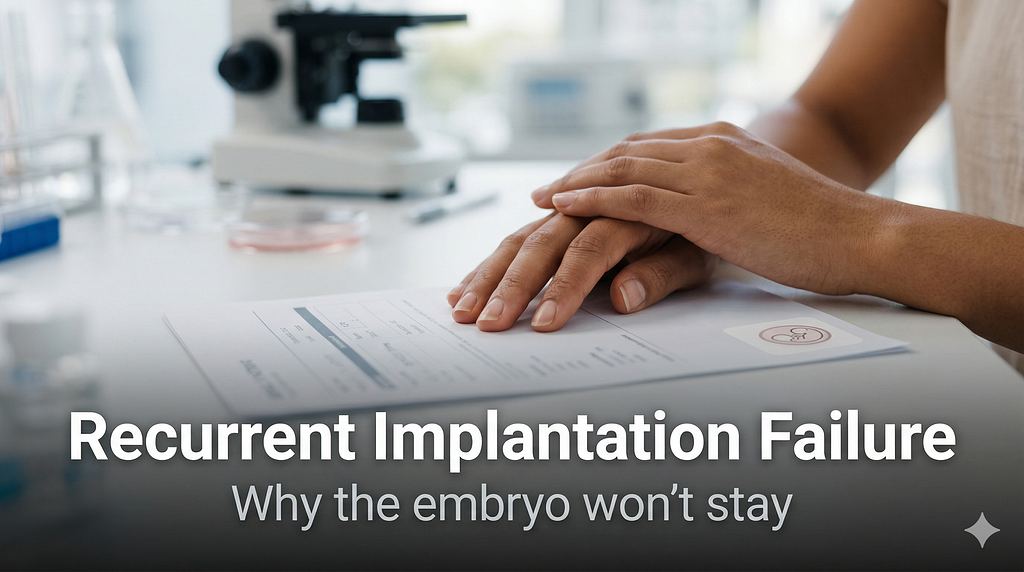
The Field That Forgets to Hold
Imagine a farmer, year after year, preparing the same plot of land. The soil is tilled, the seed is of the finest quality, and the season is right. Yet, each time, the seed fails to sprout. It rests on the surface for a moment, then seems to vanish, leaving no trace of life.
This is the silent, recurring heartbreak of recurrent implantation failure (RIF) in fertility. For many couples in Bhubaneswar, Ranchi, or Patna, it’s the cycle of hope, transfer, and a negative test that feels like a personal failure of the body’s most fundamental soil- the womb.
The Unspoken Weight of ‘Again’
You’ve done everything ‘right’. The injections, the scans, the hope held so carefully. You see the embryo picture, a beautiful cluster of cells with so much potential. You wait. And then, the bleeding starts, or the test stays stubbornly blank. The question isn’t just ‘why?’. It’s ‘why my body?’. A quiet shame whispers that you are a field where nothing can grow. The science feels distant, and the emotional toll is a private burden, often shouldered alone.
What’s Really Happening: When the Soil Rejects the Seed
In fertility, implantation is the delicate moment when the embryo (the seed) must attach to the uterine lining (the soil).
For it to succeed, three things must align perfectly: the seed must be viable, the soil must be receptive, and the environment must be peaceful.
First, the seed quality. Not every embryo that looks good under a microscope has the correct chromosomal blueprint to develop. This is often beyond what standard grading can see. Sometimes, the issue originates from the genetic material of the sperm or egg — a factor that involves both partners equally.
Second, the soil receptivity. The lining must be the right thickness, with a specific pattern of blood flow and hormonal signals. But there are hidden factors. Think of the immune system as the field’s security detail. Sometimes, it becomes overactive, mistaking the embryo for an invader and attacking it, a process mediated by natural killer cells and other immune factors.
Third, the environmental peace. Chronic, low-grade inflammation in the body like a subtle, persistent rot in the soil, can create a hostile environment. This can be due to conditions like endometriosis, thyroid imbalance, or high oxidative stress, which acts like rust on cellular machinery.
Why Tests Feel Confusing After RIF
Often, after a failed cycle, basic tests come back ‘normal’. This is because standard fertility workups don’t always probe the deeper layers of implantation biology.
The ERA Test (Endometrial Receptivity Array): This checks if your uterine lining is receptive on the exact day of transfer. It’s like testing if the soil’s chemical balance is ready for planting on day 5, not day 6. A displaced ‘window of implantation’ is a common, hidden cause.
PGT-A (Preimplantation Genetic Testing for Aneuploidy): This tests embryos for chromosomal normality before transfer. It helps select the genetically competent ‘seed’, reducing transfers of embryos that would never implant. The frustration of ‘normal’ results is valid. In medicine, ‘normal’ often means within a population range, not optimal for conception. Your personal optimal may be different.
What You Can Actually Do
1. Investigate the Immune Landscape: Ask your doctor about a basic immune panel. This isn’t about blame, but about understanding if your body’s defences need gentle modulation to welcome an embryo.
2. Consider an ERA Test: If you’ve had one or more failed transfers with good-quality embryos, this test can pinpoint if the transfer timing is off.
3. Address Hidden Inflammation: A simple dietary shift, increasing omega-3s (found in flaxseeds, walnuts) and reducing processed sugars, can lower inflammatory markers that may affect implantation.
4. Evaluate Sperm DNA Fragmentation: This is a crucial, often skipped test for the male partner. High fragmentation can lead to embryos that start developing but lack the genetic integrity to implant or grow further.
5. Mindset Reframe: RIF is a medical diagnosis, not a spiritual failing. It is a problem of biology, not destiny. Separating your self-worth from your treatment outcome is the first step toward resilient hope.
Santaan Insight
• In our eastern India clinics, we find that over 40% of couples with RIF have an undiagnosed factor, often thyroid autoimmunity or a displaced implantation window, that was missed in previous ‘normal’ workups.
• Male factor contributes to up to 50% of implantation failure cases through sperm DNA damage, a fact still under-discussed in many settings.
• Personalised protocols based on deeper testing have been shown to improve implantation rates significantly, moving beyond the ‘one-size-fits-all’ IVF approach.
A Path Forward, Together
The journey after recurrent implantation failure requires not just advanced science, but deep compassion and a detective’s approach to your unique biology.
At Santaan, our Recurrent Implantation Failure Clinic is built for this precise challenge. We look beyond the standard protocol to find your ‘why’.
You don’t have to walk this path alone. Let’s look at your history together, explore the tests that might have been missed, and build a plan that addresses the root cause.
Take the next gentle step: Book a detailed review consultation with our RIF specialists. We’ll analyse your previous cycles and recommend a personalised diagnostic pathway.
At Santaan, we meet you where the science is and where you are.
Begin Your Personalised Review with Santaan.
WhatsApp us at: +91 97772 68743