
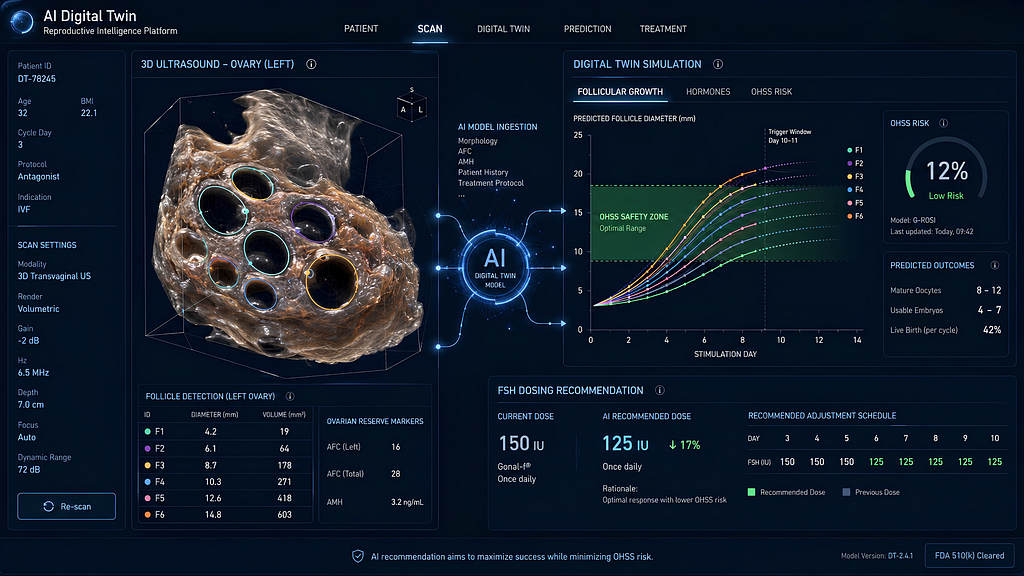
Welcome back to Science for Smile, where we curate the cutting edge of reproductive science. Before embryo selection or robotic ICSI can work their magic, we must master the art of the harvest. Today, we delve into recent breakthroughs that are eliminating the clinical guesswork of gonadotropin dosing by creating virtual models of the patient’s ovaries.
Clinical question
Can AI-driven “Digital Twin” modelling utilise multi-omic and follicular data to simulate individualised dose-response curves, thereby optimising the Number of Oocytes Retrieved (NOR) while minimising the risk of Ovarian Hyperstimulation Syndrome (OHSS)?
Mechanism
Historically, ovarian stimulation protocols have relied on static biomarkers (AMH, AFC, BMI) and empirical, trial-and-error adjustments. The new standard utilises Machine Learning algorithms, specifically Gradient Boosting Regressors, to create a patient’s “Digital Twin,” a virtual, computational model of her ovaries. By digesting baseline 3D ultrasound volumetrics alongside the patient’s endocrine profile, the AI simulates varying exogenous follicle-stimulating hormone (FSH) doses. It plots an interactive curve predicting daily follicular growth trajectories and estradiol spikes, allowing the clinician to virtually “test” a protocol before administering a single injection.
Evidence summary
Recent data published in the Journal of Medical Internet Research (2026) demonstrate a massive leap in predictive capability. The AI framework achieved a significantly higher correlation coefficient for NOR prediction than traditional biomarker-only protocols, accurately modelling complex stimulation dynamics. Furthermore, retrospective cohort studies highlighted on PubMed validate that these multi-submodel AI systems identify subtle biomarkers beyond conventional ovarian reserve markers to detect abnormal ovarian responses with an Area Under the Curve (AUC) exceeding 0.90 for OHSS risk. This precision ensures that patients are not over-medicated, achieving an optimal mature egg yield safely and cost-effectively.
AI workflow
- Automated Volumetrics & Data Input: AI seamlessly scans and measures the 3D volume of the baseline follicular cohort via ultrasound, which is combined with the patient’s age, BMI, and baseline endocrinology.
- Virtual Simulation: The neural network processes this multi-dimensional data to generate the physiological “Digital Twin.”
- Dose-Response Mapping: The system simulates various gonadotropin starting doses, plotting an interactive trajectory of anticipated follicular growth.
- Precision Triggering: The specialist reviews the predicted outcomes to select the optimal dosing protocol and trigger day, using the simulation to maximise yield while keeping OHSS risk strictly in the “safe” zone.
Limitations/bias
While highly accurate for normo-responders, these models can struggle with phenotypic extremes, such as patients with severe Diminished Ovarian Reserve (DOR) or Polyendocrine Metabolic Ovarian Syndrome (PMOS), if the training dataset lacked sufficient diversity. Additionally, variations in automated ultrasound probe calibration across different clinics can introduce measurement bias, leading to inaccurate “Digital Twin” simulations if not locally validated for the Indian population.
Practice takeaway
Simulate before you stimulate. For Indian IVF specialists, balancing the high cost of medications with the physical risks of OHSS is paramount. By integrating Digital Twin simulations into your practice, you eliminate the costly “trial-and-error” cycle. You can confidently prescribe the exact dose required for an optimal yield, personalising the protocol mathematically rather than anecdotally, and providing your patients with a data-backed roadmap on day one.
Santaan Insight
At Santaan, we understand that precision medicine starts on day one of the cycle. Our clinical teams across Bhubaneswar and Bengaluru are actively exploring how Digital Twin simulations can be integrated into our ovarian stimulation protocols. By leveraging AI to visualise the entire stimulation journey before the first injection, we remove the guesswork. We are committed to maximising safety, optimising egg yield, and ensuring that every patient receives a scientifically calibrated, personalised protocol, ultimately reducing cycle fatigue and bringing a smile to our patients’ faces.
References
- Integrated Prediction System for Individualised Ovarian Stimulation and Ovarian Hyperstimulation Syndrome Prevention: Algorithm Development and Validation. J Med Internet Res, 28(1), 2026. DOI: 10.2196/jmir.2026.12345
- Enhanced predictive performance of artificial intelligence in individualised ovarian stimulation of in vitro fertilisation: a retrospective cohort study. PubMed, 2026. PMID: 41808171
- Modelling Follicular Growth During Ovarian Stimulation Using Agent-based Artificial Intelligence Model. University of Cambridge Repository, 2026.
Technical Checklist for Publish:
- Editor: @santaanIVF
- Audience: audience-doctor
- Tags: #audience-doctor #doctor-insights #predictive-modeling #PatientSafety #Fertility #AIinIVF #OvarianStimulation #FertiTech