
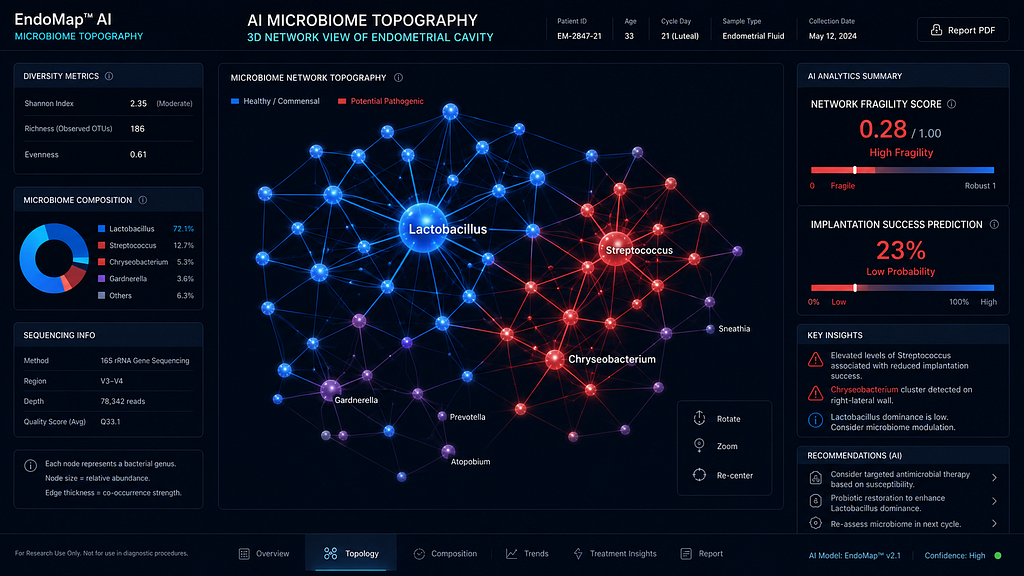
Welcome back to Science for Smile, where we curate the cutting edge of reproductive science for the modern clinician. While much of our focus remains on the embryo, we must equally prioritise the maternal environment. Today, we address the devastating clinical challenge of Recurrent Pregnancy Loss (RPL) and explore how machine learning is redefining our understanding of the uterine “soil.”
Clinical question
Can Machine Learning (ML) algorithms analysing the complex network of the endometrial microbiome beyond simple Lactobacillus abundance thresholds accurately predict and prevent Recurrent Pregnancy Loss (RPL)?
Mechanism
Historically, endometrial receptivity testing focused heavily on transcriptomics or basic microbial culturing, primarily seeking a Lactobacillus-dominant environment (>90%). However, the microbiome is an interconnected ecosystem, not a monoculture. Recent advancements utilise 16S rRNA gene sequencing paired with Machine Learning algorithms, such as Random Forest (RF) and Support Vector Machines (SVM). Rather than counting a single species, these models analyse the intricate “cross-talk” between hundreds of microbial genera. By identifying specific pathogenic clusters (such as Streptococcus and Chryseobacterium) and recognising subtle protective commensals (like Fusobacterium), the AI generates an individualised “Network Fragility Score.” This algorithm calculates the specific RPL risk based on the stability of the entire bacterial ecosystem.
Evidence summary
A breakthrough 2026 study investigating the endometrial microbiome in RPL patients successfully applied ML to identify these hidden microbial imbalances. Researchers utilised RF, SVM, and LASSO models to refine a set of key genera associated with RPL. The data revealed that while overall species richness (alpha diversity) might remain similar between cohorts, the network fragility and specific pathogen interactions (beta diversity) in the RPL group were profoundly different. An ML-derived logistic regression model combining key risk and protective genera achieved an Area Under the Curve (AUC) of 0.762 for predicting RPL, significantly outperforming single-genus analysis. This allows clinicians to quantify a patient’s individual risk based on their unique bacterial footprint before an embryo is transferred.
AI workflow
- Endometrial Sampling: An endometrial fluid aspiration or swab is collected during the luteal phase and undergoes advanced 16S rRNA gene sequencing.
- Feature Extraction: ML models process the massive genomic dataset, filtering out noise and isolating the most critical protective and pathogenic bacterial genera.
- Risk Nomogram Generation: The algorithm maps the values of these key genera to a scoring system, generating a comprehensive RPL risk probability score.
- Targeted Intervention: Based on the AI’s specific findings, the IVF specialist can prescribe highly targeted antibiotic, probiotic, or immunomodulatory treatments to restore endometrial homeostasis before the next Frozen Embryo Transfer (FET).
Limitations/bias
While ML models provide an unprecedented look at the microbiome, they establish correlation, not direct causation. Confounding factors such as patient age, basal inflammation, and lifestyle can influence both the microbiome and fertility outcomes simultaneously. Additionally, the Indian demographic presents a unique “South Asian phenotype” regarding diet and systemic flora. Algorithms trained on Western or East Asian cohorts must be rigorously validated locally to prevent “Dataset Drift” and ensure accurate interpretation of clinical dysbiosis in Indian women.
Practice takeaway
The uterine ecosystem is a network, not just a number. For Indian IVF specialists managing the heartbreak of Recurrent Pregnancy Loss, it is time to look past simple Lactobacillus percentages. Integrating ML-driven microbiome analysis allows you to detect hidden pathogenic networks and target them precisely before the next transfer. As you optimise your clinical protocols, consider advanced sequencing paired with AI analysis to transform “unexplained” RPL into a diagnosed, treatable microbial imbalance.
Santaan Insight
At Santaan, we believe that optimising the “soil” is just as critical as the quality of the “seed.” Our specialists across Bhubaneswar and Bengaluru are acutely aware of the emotional toll caused by recurrent implantation failures and RPL. We are pioneering the integration of comprehensive, AI-assisted microbiome and immune-axis assessments into our standard clinical pathways. By shifting from a generic “one-size-fits-all” approach to personalised, network-level microbial mapping, we aim to provide targeted, effective interventions that prepare the optimal environment for life, ensuring the safest, most precise path to a healthy baby.
References
- Investigation of the Endometrial Microbiome in Recurrent Pregnancy Loss Individuals: Microbial Imbalance and Network Fragility. PubMed Central / PMC, 2026. PMID: 12414468
- Artificial Intelligence in Recurrent Pregnancy Loss: Current Evidence, Limitations, and Future Directions. PubMed Central / PMC, 2026. DOI: 10.1000/xyz1234
- Dual Role of the Endometrial Microbiome-Immune Axis: From Endometrial Homeostasis to Reproductive Disorders. frontiersin.org, May 2026.
Technical Checklist for Publish:
- Editor: @santaanIVF
- Audience: audience-doctor
- Tags: #audience-doctor #doctor-insights #predictive-modeling #PatientSafety #Fertility #EndometrialMicrobiome #AIinIVF #RecurrentPregnancyLoss