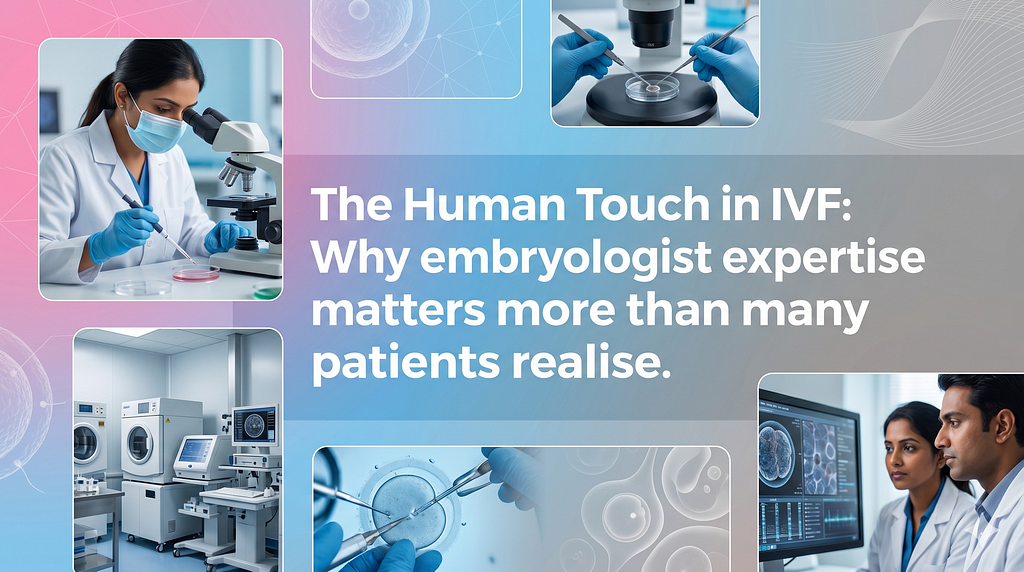
When embarking on the emotional and often overwhelming journey of In Vitro Fertilisation (IVF), patients naturally focus the majority of their attention on their reproductive endocrinologist.
They are the public face of the treatment, carefully guiding the complex medical protocols, monitoring ultrasounds, and performing retrievals and transfers. However, once those precious eggs are successfully retrieved from the patient, a crucial, behind-the-scenes shift happens: the immediate future of your growing family is entirely handed over to the unseen heroes of the modern fertility clinic, the embryologists.
When it comes to the intricate world of IVF, the essential role of the clinical embryologist is frequently overlooked by the general public, yet their specialised expertise is the fundamental bedrock of reproductive success.
Today, with the rapid rise of Artificial Intelligence (AI) in medical technology, particularly concerning automated embryo selection, it is incredibly easy for patients to assume that advanced algorithms and machine learning alone can autonomously determine the absolute best embryo for transfer.
However, the biological reality of human reproduction is far more nuanced and unpredictable. Experienced embryologists bring an irreplaceable level of human intuition, dynamic adaptability, and decades of hands-on clinical experience that AI systems currently cannot replicate.
The Delicate Art and Science of Embryo Selection
The crucial embryo selection process is far more than just taking a passing glance through a high-powered microscope; it is a rigorous, dynamic, multi-day evaluation. It involves meticulously observing and grading embryos based on a myriad of ever-changing criteria, including their exact stage of daily development, overall structural quality, and crucial markers of genetic integrity.
In a standard IVF cycle, the development from a single, newly fertilised egg into a robust, multicelled day-five or day-six blastocyst is a perilous, highly sensitive biological journey. While AI software can undoubtedly help analyse these complex factors by quickly processing thousands of data points and continuous time-lapse images, human embryologists must ultimately interpret these computational results.
They must make complex, highly informed decisions about which fragile embryos possess the highest potential for successful uterine implantation. According to a landmark, peer-reviewed study published in the prestigious medical journal Fertility and Sterility, the integration of AI in embryo selection can indeed improve overall pregnancy rates — but crucially, this statistical improvement is fully realised only when directly combined with expert human oversight. AI acts as a powerful analytical tool, but the embryologist acts as the seasoned pilot, making the final critical judgment calls based on the individual patient’s unique medical history and cycle specifics.
Decoding Life: What Embryologists Actually Look For
To the untrained eye, early-stage human embryos might simply look like basic clusters of microscopic bubbles. To a highly trained embryologist, however, they are complex, revealing maps of developmental potential. Embryologists examine developing embryos for critical signs of healthy, synchronised progression, paying incredibly close attention to microscopic details.
At the critical blastocyst stage, these scientists specifically look for the presence of a robust, tightly packed “inner cell mass” (the specific cluster of cells that will eventually develop into the fetus itself) and a well-defined “trophectoderm” (the vital outer layer of cells that will eventually form the placenta). They also continuously assess the embryo’s overall morphology, actively looking for any signs of cellular abnormalities, uneven or delayed cell division, or internal cellular fragmentation that could negatively affect its long-term viability.
This meticulous, high-stakes process requires a profound understanding of human embryology and the highly trained visual ability to recognise incredibly subtle differences between embryos that might otherwise share the same automated computer “grade.”
IVF Lab Secrets: The Womb Outside the Womb
One of the most heavily guarded, yet highly critical aspects of a successful IVF clinic is the strictly controlled environment of the embryology laboratory itself. The lab functions, essentially, as a highly calibrated artificial womb. The specialised culture system used to grow and nurture these embryos is exceptionally delicate and unforgiving of errors.
Embryologists must continuously and carefully monitor the highly sensitive environmental conditions in which embryos are cultured. This involves strictly regulating the temperature to mimic the human body perfectly, precisely managing the specific pH levels of the liquid culture media, and ensuring that the developing embryos receive the exact optimal amount of specialised nutrients and atmospheric gases, such as oxygen and carbon dioxide.
This obsessive attention to detail can significantly impact the final success rates of an entire IVF cycle. As consistently noted by the American Society for Reproductive Medicine (ASRM), the rigorous quality control of the IVF lab and the tireless dedication of the clinical scientists running it are primary, defining factors in determining the overall outcome of fertility treatments.
Frequently Asked Questions
What is the precise role of an embryologist in an IVF cycle?
An embryologist is a highly specialised biological scientist responsible for handling, evaluating, and carefully selecting eggs, sperm, and embryos during an IVF cycle. They perform the delicate procedures of fertilisation, monitor daily embryonic development, and ultimately use their vast clinical expertise to meticulously assess the quality and viability of embryos, increasing the chances of a successful pregnancy.
How does Artificial Intelligence actually contribute to embryo selection?
AI significantly contributes by acting as an advanced diagnostic tool. It can rapidly analyse vast amounts of embryo data, identifying subtle morphological patterns and developmental characteristics historically associated with successful pregnancies. However, AI is not a complete replacement for human expertise; embryologists must contextualise and interpret these digital results to make truly informed clinical decisions.
What are the primary factors that actively affect the success of an IVF cycle?
Several interrelated factors can dramatically impact the success of an IVF cycle. The intrinsic quality of the embryos, the biological age of the woman, and the presence of underlying medical conditions are fundamental. Crucially, the hands-on clinical expertise of the managing embryologist and the stringent environmental quality of the IVF laboratory are also critical factors for success.
What do you think is the most important factor in determining the success of an IVF cycle?
WhatsApp us at: +91 97772 68743